


RCM certification validates competence in Reliability Centered Maintenance, the methodology defined in SAE JA1011 that determines optimal maintenance strategies by answering 7 fundamental questions about each asset. Furthermore, the most recognized credential covering RCM is the CMRP (Certified Maintenance & Reliability Professional) administered by SMRP. This guide explains what RCM certification is, the requirements, exam format, cost, and how to get certified.
Important: RCM certification in this guide refers to Reliability Centered Maintenance certification for physical asset management. It is not the medical Revenue Cycle Management certification (healthcare billing). If you searched for “RCM certification medical,” this page covers a different credential entirely.
Table of Contents
What Is RCM Certification?
RCM certification validates a professional’s competence in the Reliability Centered Maintenance methodology — the structured process of answering the 7 SAE JA1011 questions to determine optimal maintenance strategies for each asset. Furthermore, it is important to understand that there is no single “RCM certification” issued by one body. Instead, RCM competence is validated through two main paths: the CMRP credential (which covers RCM as one of five pillars) and dedicated RCM training certificates from approved providers.
Specifically, the CMRP (Certified Maintenance & Reliability Professional) is the most widely recognized credential that includes RCM. Administered by SMRP (Society for Maintenance & Reliability Professionals), the CMRP validates competence across five pillars: Business Management, Equipment Reliability (which includes RCM), Manufacturing Process Reliability, Organizational Leadership, and Work Management. Therefore, earning the CMRP demonstrates RCM competence alongside broader reliability engineering skills. For the full credential overview, see our RCM certification guide.
Moreover, dedicated RCM training certificates are offered by approved training providers and typically focus exclusively on the 7-question RCM methodology. Furthermore, some organizations require these dedicated certificates for internal RCM facilitators, while the CMRP is preferred for broader reliability engineering roles. Consequently, the right credential depends on whether you want to facilitate RCM analyses specifically or build a broader reliability career. For the foundational methodology, see our reliability centered maintenance guide.
In addition, the RCM acronym is ambiguous — it also stands for Revenue Cycle Management in healthcare. Therefore, when researching “RCM certification,” confirm you are looking at Reliability Centered Maintenance (asset management) and not Revenue Cycle Management (healthcare billing). This guide covers only the asset management credential. For the broader asset management standard, see ISO 55000 and the Wikipedia RCM overview.
RCM Requirements & Eligibility
Before pursuing RCM certification, confirm you meet the eligibility requirements for your chosen credential. Furthermore, the table below summarizes the CMRP requirements, which is the primary path to RCM certification.
| Requirement | Detail | Notes |
|---|---|---|
| Education | Minimum of a technical diploma or equivalent experience | Engineering, maintenance, or reliability field preferred |
| Experience | 3-5 years in maintenance, reliability, or related field | Direct RCM or reliability engineering experience counts |
| SMRP membership | Optional but reduces exam fee | $175/year; saves $50 on exam |
| Training (recommended) | SMRP-approved preparation or self-study of Body of Knowledge | Not mandatory but strongly recommended |
| Application | Submit application with fee to SMRP | Approval required before scheduling |
| Recertification | Every 3 years with professional development | $150 member / $175 non-member |
Specifically, the CMRP does not require formal RCM training — candidates can self-study the SMRP Body of Knowledge, which includes RCM as part of the Equipment Reliability pillar. However, most successful candidates combine self-study with structured preparation. Furthermore, candidates from non-engineering backgrounds can qualify with sufficient maintenance or reliability experience. Therefore, if your background is non-traditional, contact SMRP to confirm eligibility. For training options, see our RCM training and RCM course guides.
RCM Exam Format (CMRP)
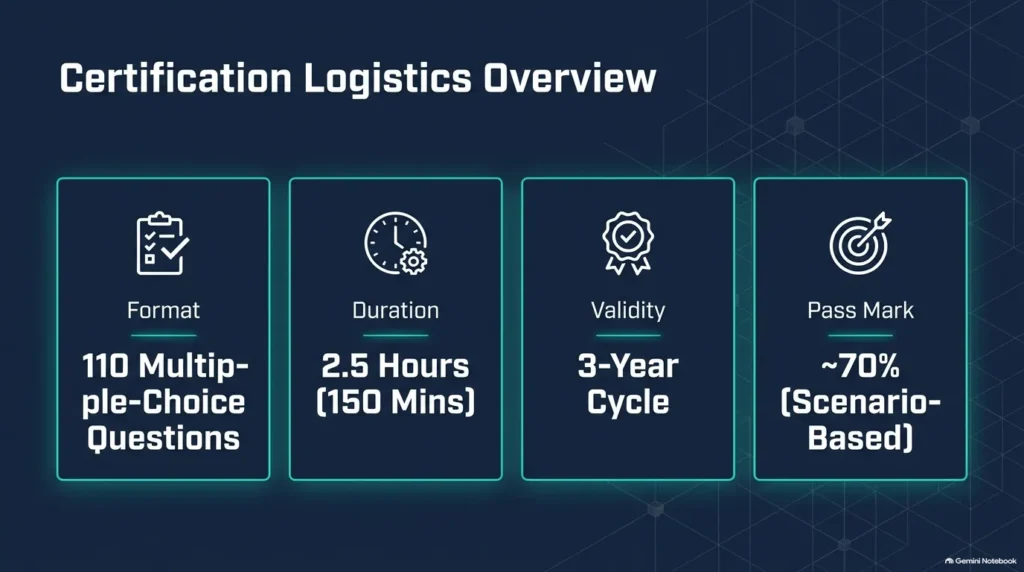
The CMRP exam — the primary credential covering RCM — is a single, computer-based, multiple-choice exam. Furthermore, understanding the format helps you prepare efficiently.
| Attribute | Detail |
|---|---|
| Questions | 110 multiple-choice |
| Time limit | 2.5 hours (150 minutes) |
| Passing score | ~70% (subject to change) |
| Domains | 5 pillars (Business Mgmt, Equipment Reliability, Mfg Process Reliability, Org Leadership, Work Mgmt) |
| RCM coverage | Within Equipment Reliability pillar (~20% of exam) |
| Delivery | Computer-based, authorized testing center |
| Question style | Scenario-based, applied judgment |
| Validity | 3 years |
Specifically, the Equipment Reliability pillar — which includes RCM — accounts for approximately 20% of the exam. Furthermore, questions in this pillar test applied judgment: you must look at a scenario and determine the correct maintenance strategy using RCM principles. Therefore, the best preparation combines theoretical RCM study with scenario-based practice. For realistic preparation, our CMRP practice test mirrors the exam format with free questions and instant scoring.
RCM Certification Cost
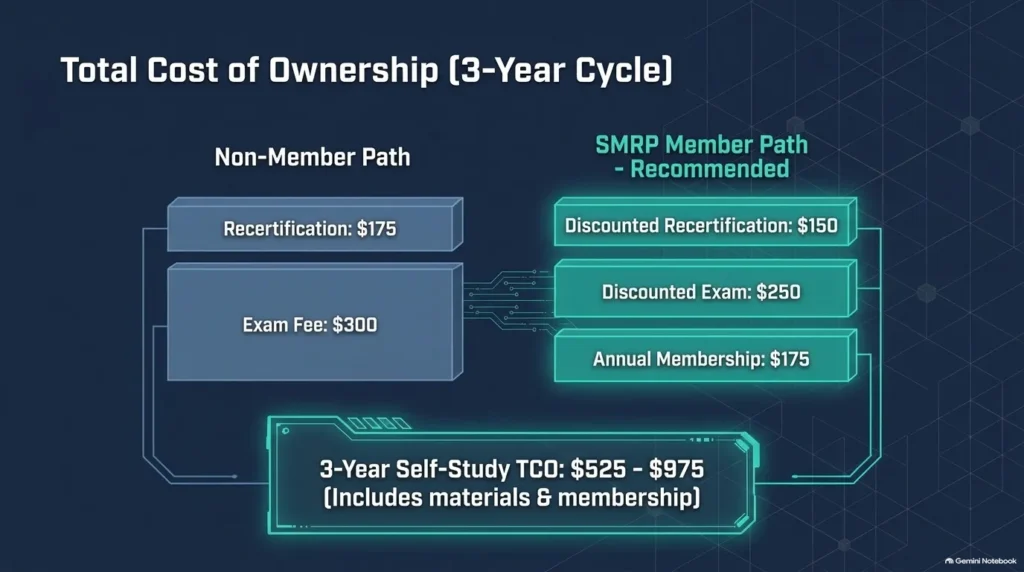
The cost of RCM certification extends beyond the exam fee to include training, study materials, and recertification. Furthermore, the table below breaks down every cost component.
| Cost Item | SMRP Member | Non-Member | Frequency |
|---|---|---|---|
| Exam fee | $250 | $300 | One-time |
| SMRP membership | $175/yr | — | Annual |
| Study materials | $50-$200 | $50-$200 | One-time |
| Practice test (ReliabilityPath) | Free | Free | Unlimited (free tier) |
| Training course (optional) | $500-$2,000 | $500-$2,000 | One-time |
| Recertification | $150 | $175 | Every 3 years |
Total Cost of Ownership (3-Year Cycle)
| Scenario | Year 1 | 3-Year Total |
|---|---|---|
| SMRP member, self-study | $475-$625 | $825-$975 |
| Non-member, self-study | $350-$500 | $525-$675 |
| SMRP member, with training | $975-$2,625 | $1,325-$2,975 |
| Non-member, with training | $850-$2,500 | $1,025-$2,675 |
Consequently, RCM certification via the CMRP is one of the most affordable professional credentials — the self-study path costs as little as $525-$975 over 3 years. Furthermore, SMRP membership pays for itself through the $50 exam discount. Therefore, most candidates benefit from joining SMRP before applying. For the complete cost analysis, see our CMRP certification cost guide.
How to Get Certified (Step by Step)
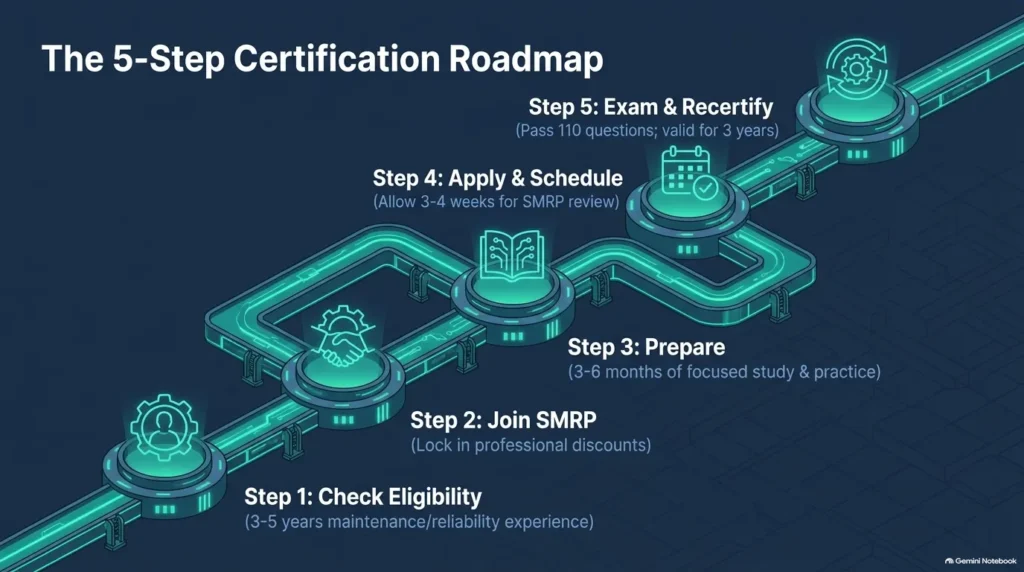
Step 1: Check Eligibility
Confirm you meet the SMRP eligibility requirements. Furthermore, verify that your experience qualifies — maintenance, reliability, or related engineering experience all count. Therefore, if your background is non-traditional, contact SMRP before investing in preparation.
Step 2: Join SMRP (Optional but Recommended)
Join SMRP to access the member exam fee discount ($50 savings) and training resources. Furthermore, membership provides ongoing professional development and networking. Therefore, join before applying to maximize savings.
Step 3: Prepare with Study & Practice
Study the SMRP Body of Knowledge, which includes RCM within the Equipment Reliability pillar. Furthermore, supplement self-study with scenario-based practice tests. Most candidates need 3-6 months of preparation. In addition, our free CMRP practice test helps assess readiness before booking the exam.
Step 4: Apply & Schedule
Submit your application to SMRP with the required fee ($250 member / $300 non-member). Once approved, schedule your computer-based exam at an authorized testing center. Furthermore, pick a date that leaves 3-4 weeks for final review.
Step 5: Take the Exam & Recertify
Sit the 110-question, 2.5-hour exam. Pass with approximately 70% to earn the CMRP credential. Consequently, the credential is valid for 3 years, after which you must recertify. Therefore, track your professional development from day one. For more on the RCM methodology, see our RCM analysis guide.
Is RCM Certification Worth It?
The ROI of RCM certification (via CMRP) is compelling. Furthermore, the table below summarizes the factors that determine whether the investment pays off.
| Factor | Detail | Verdict |
|---|---|---|
| Career advancement | CMRP opens reliability engineering and management roles | ✓ Strong ROI |
| Salary impact | CMRP-certified professionals earn $90,000-$130,000+ (varies by region) | ✓ Positive |
| Employer demand | Asset-intensive industries increasingly require CMRP for reliability roles | ✓ Growing |
| Cost vs. salary gain | Total 3-year cost $525-$2,975 vs. $5k-$15k+/year premium | ✓ Pays for itself in year 1 |
| Recertification burden | 3-year renewal with professional development tracking | ⚠ Manageable |
| Alternative credentials | CAMA covers asset management systems; CMRP covers reliability practice | Complementary |
Specifically, the CMRP pays for itself within the first year: a $525-$975 self-study investment against a $5,000-$15,000 annual salary premium. Moreover, the credential is increasingly demanded by asset-intensive organizations building reliability programs. Therefore, the long-term career value significantly exceeds the upfront cost. For salary details, see our CMRP certification salary guide.
Nevertheless, RCM certification is not for everyone. If your role is purely maintenance execution without reliability engineering responsibilities, the credential may be underutilized. Furthermore, if your employer does not value professional credentials, the salary premium may not materialize. Consequently, evaluate your career trajectory before committing. For professionals focused on asset management systems, the CAMA may complement the CMRP well.
Frequently Asked Questions
These questions address the most common searches around RCM certification, including all PAA questions. For the full set of certification questions, see our FAQs hub.
What is an RCM certification?
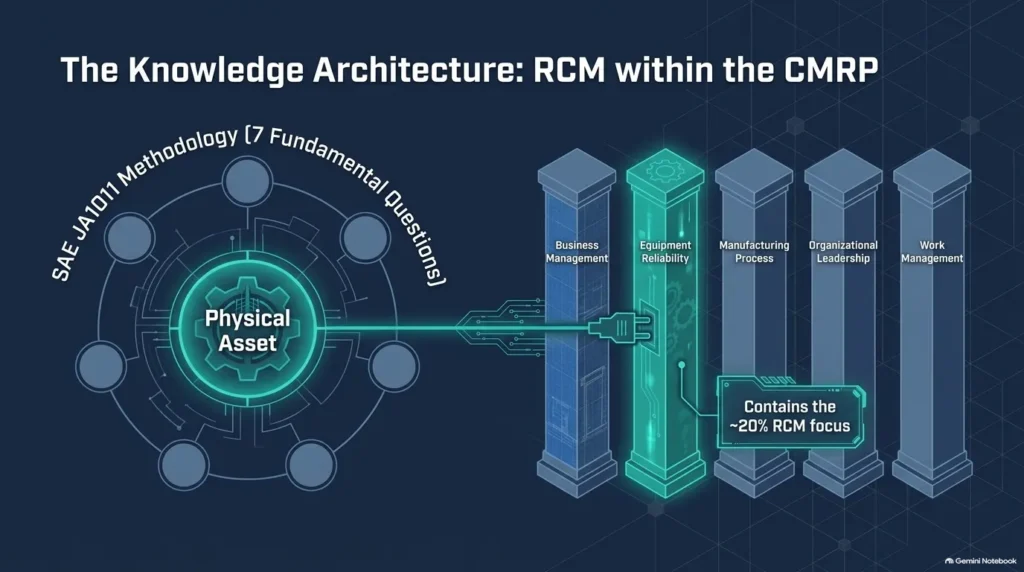
RCM certification validates competence in Reliability Centered Maintenance, the methodology defined in SAE JA1011 that determines optimal maintenance strategies by answering 7 fundamental questions about each asset. Furthermore, the most recognized credential covering RCM is the CMRP (Certified Maintenance and Reliability Professional) by SMRP, which includes RCM within its Equipment Reliability pillar. Therefore, there is no single “RCM certification” — RCM is typically validated through CMRP or dedicated RCM training certificates. Importantly, RCM certification is not the medical Revenue Cycle Management certification.
How hard is RCM?
RCM certification difficulty is moderate. Specifically, the CMRP exam has 110 multiple-choice questions in 2.5 hours with a ~70% pass mark. Furthermore, the exam tests applied judgment through scenario-based questions, not rote memorization. Consequently, most candidates pass with 3-6 months of preparation using the SMRP Body of Knowledge and practice tests. Therefore, the difficulty is manageable for professionals with maintenance or reliability experience. For realistic preparation, try our CMRP practice test.
How to get RCM certification?
To get RCM certification, confirm you meet SMRP eligibility requirements, submit an application with the fee ($250 member / $300 non-member), schedule the 110-question computer-based exam, pass with approximately 70%, and recertify every 3 years. Furthermore, preparation typically takes 3-6 months using the SMRP Body of Knowledge and practice tests. Therefore, start with a free practice test to assess your baseline before committing to paid training. For the step-by-step guide, see our RCM certification guide.
How long does it take to get an RCM certificate?
It takes 3-6 months to prepare for RCM certification (via CMRP) and one exam sitting to earn the credential. Specifically, the exam itself is 2.5 hours. Once passed, the credential is valid for 3 years, after which you must recertify. Therefore, the total timeline from decision to certified is typically 4-7 months including application, preparation, and exam scheduling.
Is RCM certification the same as medical RCM certification?
No. RCM certification in this guide refers to Reliability Centered Maintenance certification for physical asset management, governed by SAE JA1011 and validated through the CMRP credential. Furthermore, it is not the medical Revenue Cycle Management certification (healthcare billing). Therefore, if you searched for “RCM certification medical,” you need a different credential — the two share only an acronym. For asset management professionals, however, the RCM certification covered here is exactly the right credential.
How much does RCM certification cost?
RCM certification cost varies by credential. Specifically, the CMRP exam costs $300 (non-member) or $250 (SMRP member), with recertification every 3 years at $150-$175. Furthermore, total cost including training, materials, and exam ranges from $525 to $2,975 over a 3-year cycle. Therefore, budget for the full cycle rather than just the exam fee. For the complete breakdown, see our CMRP certification cost guide.
Are there RCM certification programs online?
Yes, RCM certification programs are available online. Specifically, the CMRP exam is delivered computer-based at authorized testing centers, and preparation can be done entirely online using self-paced courses, study materials, and practice tests. Furthermore, our free CMRP practice test and full simulator ($16) support online preparation. Therefore, you can prepare for RCM certification online from anywhere. For training options, see our RCM training guide.
Ready to Get RCM Certified?
RCM certification — via the CMRP — is a strategic investment that pays for itself within the first year for most professionals. Furthermore, it opens doors to reliability engineering and management roles in asset-intensive industries. To assess your readiness before committing to paid training, take our free RCM practice test. Then explore our RCM training and RCM course guides. For the complete methodology, read our reliability centered maintenance guide and the RCM analysis resource. For the cost breakdown, see the CMRP certification cost guide. For salary, see the CMRP salary resource. When you are ready, view all exam simulators and take the next step.
ReliabilityPath builds exam simulators for CMRP, CAMA, and RCM certifications, grounded in the SAE JA1011/JA1012 standards and the SMRP Body of Knowledge.
RCM Analysis: The 7 SAE JA1011 Steps Explained (2026)
[…] maintenance strategy. The RCM analysis process is tested on certification exams like the CMRP and RCM certification, where candidates must apply the 7 SAE JA1011 questions to realistic industrial scenarios. Exam […]