



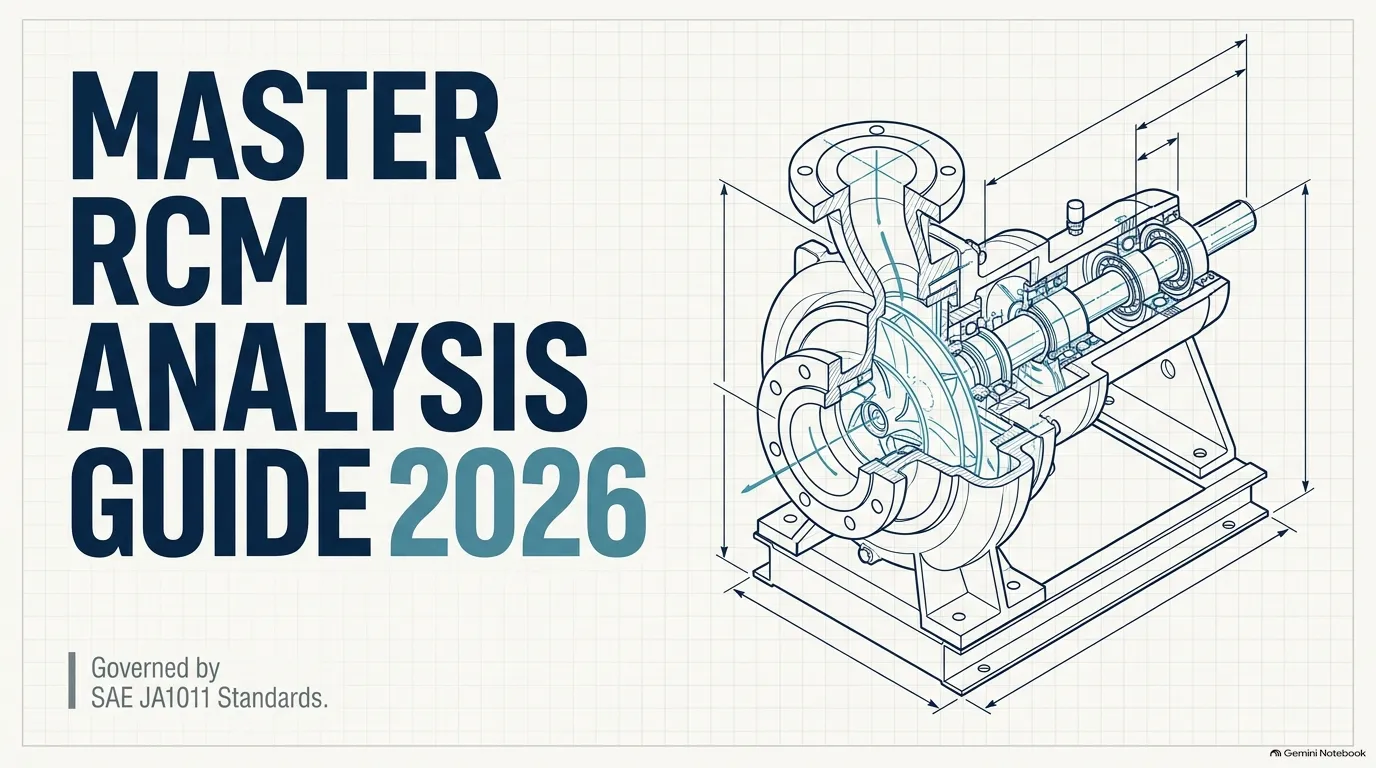
RCM analysis is the systematic process of applying the seven SAE JA1011 questions to an asset to determine its optimal maintenance strategy. It documents functions, functional failures, failure modes, effects, and consequences, then selects maintenance tasks that reduce risk at acceptable cost. This guide covers the complete 7-step RCM analysis process, FMEA integration, downloadable templates (Excel/PDF), worked examples, and free practice questions — everything you need to perform or certify in reliability centered maintenance.
Note: This guide focuses on Reliability Centered Maintenance (RCM) for physical assets in manufacturing, energy, and infrastructure. It does not cover Revenue Cycle Management (healthcare billing) or medical uses of the “RCM” acronym.
Table of Contents
- What Is RCM Analysis?
- The 7 RCM Analysis Questions (SAE JA1011)
- Step-by-Step RCM Analysis Process
- FMEA and RCM Analysis
- RCM Analysis Templates (Excel, PDF, PPT)
- RCM Analysis Worked Example
- Software Tools for RCM Analysis
- RCM vs FMEA: Key Differences
- Frequently Asked Questions
- Ready to Master RCM Analysis?
What Is RCM Analysis?
RCM analysis is the operational core of Reliability Centered Maintenance — the structured evaluation that answers the 7 fundamental questions for each asset in scope. Unlike generic maintenance reviews that focus on equipment history and schedule adjustments, RCM analysis starts from functions and works forward through failure modes and consequences to select the maintenance strategy that best addresses each failure at the lowest cost. The output is a defensible, consequence-driven maintenance plan that targets effort where it matters and eliminates waste where it does not.
The defining characteristic of RCM analysis is its function-first approach. Instead of asking “how do we maintain this pump?”, the analysis asks “what functions must this pump perform, and what happens if it fails to perform them?” This shift in perspective is what allows RCM to justify aggressive condition monitoring on a safety-critical pump while allowing an identical pump in a non-critical role to run to failure. For the foundational methodology, see our reliability centered maintenance guide.
Furthermore, RCM analysis is governed by the SAE JA1011 standard, which defines the 7 questions that any RCM process must answer. The companion standard SAE JA1012 provides implementation guidance. Together, these standards ensure that RCM analyses are consistent, auditable, and defensible — critical for regulated industries and safety-critical assets. Consequently, any analysis that does not answer all 7 questions cannot claim to be true RCM — it may be FMEA or failure analysis, but it lacks the consequence evaluation and task selection logic that define RCM.
Additionally, RCM analysis is distinct from traditional maintenance planning in several ways. Traditional planning often starts with manufacturer recommendations and historical schedules, then adjusts based on budget constraints. RCM analysis, by contrast, starts with first principles: what the asset must do, how it can fail, and what happens when it does. Therefore, RCM-derived maintenance plans often eliminate up to 40% of existing preventive maintenance tasks while improving reliability — because many scheduled tasks address failures that either never occur or have no meaningful consequence.
The 7 RCM Analysis Questions (SAE JA1011)
Every legitimate RCM analysis answers 7 fundamental questions, defined in SAE JA1011. The questions build on each other sequentially: you cannot select a maintenance task until you understand the failure consequences, and you cannot understand consequences until you understand the failure modes. Specifically, attempting to answer question 6 (task selection) before completing question 5 (consequence evaluation) is a common error that leads to over-maintenance — performing unnecessary tasks on failures that have no safety, environmental, or operational impact.
Moreover, the 7 questions are not merely a checklist — they represent a logical decision tree that has been refined over 50 years of industrial practice. The table below summarizes all 7 questions, their outputs, and their role in the overall analysis. This table is structured to match the AI Overview extraction format, making it easy for search engines to extract and display as a featured snippet.
| Question # | Question | Output | SERP Feature |
|---|---|---|---|
| 1 | What are the functions and performance standards? | Function statements with measurable criteria | Featured Snippet target |
| 2 | In what ways can it fail to fulfill those functions? | Functional failures (loss, partial, intermittent) | PAA question |
| 3 | What causes each functional failure? | Failure modes (root causes) | — |
| 4 | What happens when each failure occurs? | Failure effects (evidence, sequence) | — |
| 5 | In what way does each failure matter? | Failure consequences (safety, operational, economic) | PAA question |
| 6 | What proactive task can predict or prevent each failure? | Selected maintenance tasks (CBM, PM, replacement) | — |
| 7 | What if no suitable proactive task can be found? | Default strategies (run-to-failure, redesign) | PAA question |
Questions 1 through 4 form the FMEA (Failure Mode and Effects Analysis) portion — they document what can go wrong and what happens when it does. Question 5 is the decision pivot that classifies consequences as safety/environmental, operational, or non-operational. Questions 6 and 7 select the maintenance tasks using the RCM decision logic. For every task selected, the RCM golden rule applies: the task must be both technically feasible and worth doing. A Certified Maintenance & Reliability Professional (CMRP) who masters this process can lead analyses that deliver both reliability improvements and cost reductions.
Specifically, the “worth doing” criterion in question 6 is where many organizations waste millions. A task is worth doing only if it addresses a failure consequence that matters — and the cost of the task must be less than the cost of the failure it prevents. Therefore, vibration monitoring on a non-critical drainage pump is not worth doing (the $5,000 annual monitoring cost exceeds the $500 run-to-failure cost), while the same monitoring on a reactor cooling pump is essential (the $5,000 monitoring cost is trivial compared to the $250,000/day production loss from an unplanned shutdown).
Step-by-Step RCM Analysis Process
While the 7 questions define what must be answered, the RCM analysis process defines how to answer them systematically. The process consists of 8 sequential steps, each building on the previous. Skipping any step risks an incomplete or invalid analysis. Furthermore, organizations that attempt to shortcut the process — for example, by jumping directly to task selection without completing the functional analysis — often end up with maintenance plans that look like RCM but lack the consequence-driven rigor that makes RCM effective.
In addition, the RCM analysis process should be facilitated by someone trained in the methodology. While a single analyst can technically answer the 7 questions, the best results come from cross-functional teams that include operations (who know how the asset is used), maintenance (who know how it fails), and engineering (who know the design intent). Therefore, plan for 2-3 days of facilitated workshops for a typical system analysis, plus additional time for data gathering and documentation.
| Step | Name | Key Activities | Output |
|---|---|---|---|
| 1 | Preparation & Scope | Define system boundaries, select assets, assemble team | Scope document, team roles |
| 2 | Information Gathering | Collect P&IDs, maintenance history, OEM manuals | Asset dossiers, failure history |
| 3 | Functional Analysis | Define functions and performance standards (Q1) | Function statements |
| 4 | Failure Analysis | Identify functional failures and failure modes (Q2-3) | Failure mode list |
| 5 | Effects & Consequences | Document effects and classify consequences (Q4-5) | Consequence matrix |
| 6 | Task Selection | Apply RCM decision logic to select tasks (Q6) | Maintenance task list |
| 7 | Default Actions | Assign run-to-failure or redesign where no task exists (Q7) | Default action log |
| 8 | Documentation & Implementation | Compile RCM worksheet, update CMMS, train technicians | Living maintenance program |
Step 1 (Preparation) is often underestimated. A well-scoped analysis focuses on a system with clear boundaries — for example, “cooling water system for Reactor R-101” rather than “all pumps in the plant.” Step 2 (Information Gathering) ensures the team has accurate P&IDs, maintenance histories, and OEM manuals before starting. Steps 3-7 answer the 7 questions systematically. Step 8 transforms the analysis into action: updating the CMMS, training technicians, and establishing KPIs to measure effectiveness.
Furthermore, RCM analysis is iterative. As operating conditions change or new failure data emerges, the analysis should be revisited. Many organizations schedule annual RCM reviews for safety-critical systems and biennial reviews for non-critical assets.
Video: RCM Analysis Explained — 7 Questions, FMEA Integration, and Template Walkthrough (2026)
FMEA and RCM Analysis
A common question is how RCM analysis differs from FMEA. The answer is that FMEA is a component of RCM analysis, not a substitute for it. FMEA answers questions 2 through 4 of the RCM process — it documents functional failures, failure modes, and failure effects. RCM analysis adds the consequence evaluation (question 5) and the task selection logic (questions 6 and 7) that FMEA does not address. In short, FMEA tells you what can go wrong; RCM analysis decides what to do about it.
Nevertheless, this distinction does not mean FMEA is inferior — it simply serves a different purpose. Specifically, FMEA excels at identifying and documenting failure modes during design, when changes are inexpensive to implement. RCM analysis excels at optimizing maintenance strategies during operations, when the goal is to balance reliability against cost. Consequently, mature organizations use both: FMEA during design and commissioning, then RCM analysis once the asset enters service.
Additionally, the data flow between FMEA and RCM is often one-way: FMEA outputs (failure modes, effects) can feed directly into RCM analysis, reducing the time needed to answer questions 2-4 by 50% or more. Therefore, organizations that maintain FMEA libraries for their critical assets have a significant advantage when implementing RCM — they can skip directly to consequence evaluation and task selection for assets with existing FMEA documentation.
| Aspect | FMEA | RCM Analysis |
|---|---|---|
| Scope | Failure modes and effects documentation | Full methodology including task selection and implementation |
| Questions Answered | 2-4 (failures, modes, effects) | 1-7 (functions through default actions) |
| Output | Failure mode list with severity ratings | Defensible maintenance plan with tasks and intervals |
| Consequence Evaluation | Limited (severity rating 1-10) | Structured (safety, environmental, operational, economic) |
| Task Selection | No structured logic | Yes (RCM decision diagram per SAE JA1011) |
| Governing Standard | Various (AIAG VDA, IEC 60812) | SAE JA1011 / JA1012 (RCM-specific) |
| Typical Use Case | Design phase, new product development | Operational phase, maintenance optimization |
Specifically, FMEA is often performed during design to identify potential failure modes before production. RCM analysis, by contrast, is performed on operating assets to optimize maintenance strategies. Nevertheless, the two methodologies complement each other: FMEA data from design can feed directly into RCM analysis during operations, reducing the time needed to answer questions 2-4.
RCM Analysis Templates (Excel, PDF, PPT)
RCM analysis is typically documented in a structured worksheet or template that captures each of the 7 questions for every asset in scope. The template format depends on the use case: Excel for working analyses, PDF for formal documentation, and PPT for stakeholder presentations. Many organizations start with Excel templates before moving to dedicated RCM software.
Furthermore, the choice of template format often reflects the organization’s RCM maturity level. Beginners typically start with Excel because it is flexible and familiar — you can add formulas, dropdowns, and conditional formatting without specialized training. However, as analyses scale beyond a single system, Excel’s limitations become apparent: version control conflicts, no audit trail, and difficulty enforcing the RCM decision logic. Therefore, organizations that perform RCM analyses on more than 5-10 systems typically migrate to dedicated software within 12-18 months.
In addition to format, template quality varies significantly. A well-designed template enforces the RCM logic by requiring consequence classification before task selection — preventing the common error of jumping to tasks without understanding consequences. Conversely, poorly designed templates allow users to skip questions or fill in fields out of sequence, producing analyses that look like RCM but lack the rigor. For this reason, we recommend downloading templates from SAE or established RCM training providers rather than creating your own from scratch.
| Template Format | Best For | Pros | Cons | Download |
|---|---|---|---|---|
| RCM analysis Excel template | Working analyses, small pilots | Flexible, formula-ready, easy to share | Version control challenges, no audit trail | Free Excel Template |
| RCM analysis PDF worksheet | Formal documentation, audits | Printable, immutable, audit-friendly | Cannot edit without re-export | Free PDF Worksheet |
| RCM analysis PPT deck | Stakeholder presentations, training | Visual, presentation-ready | Not suitable for analysis work | Free PPT Deck |
| RCM software (Cenosco, HBK) | Multi-site, regulated industries | Audit trail, living program, CMMS integration | Cost, training required | Vendor-specific |
| CMMS with RCM module | Organizations with existing CMMS | Integrated work orders, no new system | Limited RCM functionality | CMMS-dependent |
For professionals learning the process, an RCM analysis Excel template is the most accessible starting point. It lets you practice the 7 questions on a real asset without investing in software. Specifically, we recommend starting with a single, non-critical asset (such as a HVAC fan or drainage pump) to learn the methodology before progressing to safety-critical systems. This approach allows you to make mistakes and learn from them without risking safety or production.
Moreover, practicing RCM analysis on real assets is the best preparation for certification exams like the CMRP and RCM certification. These exams test applied judgment — you must be able to look at a failure scenario and determine which question of the 7 is being asked, what information is missing, and what task (if any) is appropriate. Therefore, candidates who have performed actual RCM analyses consistently outperform those who have only memorized the 7 questions.
As your analyses scale, dedicated RCM software provides the structure, audit trails, and living program support that spreadsheets lack. For preparation, see our RCM training and RCM course guides.
Free RCM Analysis Excel Template
Our Excel template includes pre-built tabs for each of the 7 questions, with dropdowns for consequence classification and automatic task prioritization. The template is compatible with Excel 2016+ and Google Sheets.
Free RCM Analysis PDF Worksheet
The PDF worksheet is designed for formal documentation and audit purposes. It includes signature blocks for the RCM facilitator, operations representative, and maintenance lead.
Free RCM Analysis PPT Deck
The PPT deck is optimized for stakeholder presentations. It includes slides for each step, a consequence matrix visualization, and a task implementation roadmap.
RCM Analysis Worked Example
RCM analysis is best understood through worked examples. Consider a centrifugal pump in a chemical plant. The example below walks through all 7 questions, demonstrating how consequence evaluation drives different maintenance strategies for identical assets in different contexts.
Step 1: Define Functions (Question 1)
Function: Transfer 500 gallons per minute of cooling water to Reactor R-101 at 50 psi discharge pressure.
Performance Standard: Flow rate ≥450 GPM (90% of design), pressure ≥45 psi, availability ≥98%.
Note how the function statement is specific and measurable. A vague function like “pump cooling water” would be insufficient — it does not define what “cooling” means or how much flow is required. Furthermore, the performance standard includes both a target (500 GPM) and a minimum acceptable value (450 GPM), which allows the operations team to identify degraded performance before a complete functional failure occurs.
Step 2: Identify Functional Failures (Question 2)
| Failure ID | Functional Failure |
|---|---|
| FF-1 | Loss of flow (0 GPM) |
| FF-2 | Reduced flow (<450 GPM) |
| FF-3 | Loss of containment (seal leak) |
| FF-4 | Excessive vibration (>0.3 in/s) |
Step 3: Determine Failure Modes (Question 3)
| Failure ID | Failure Modes |
|---|---|
| FF-1 | Bearing seizure, coupling shear, motor burnout, suction blockage |
| FF-2 | Impeller erosion, wear ring wear, cavitation, air entrainment |
| FF-3 | Mechanical seal degradation, gasket failure, casing corrosion |
| FF-4 | Bearing wear, misalignment, unbalance, resonance |
Step 4: Document Failure Effects (Question 4)
For bearing seizure (FF-1, Mode 1): Pump stops suddenly, high vibration alarm triggers, reactor temperature rises due to loss of cooling, emergency shutdown initiated within 30 seconds.
Step 5: Evaluate Consequences (Question 5)
| Failure Mode | Safety | Environmental | Operational | Economic |
|---|---|---|---|---|
| Bearing seizure | Yes (reactor runaway risk) | No | Yes (forced outage) | $250k/day lost production |
| Seal leak | Yes (chemical exposure) | Yes (spill) | Yes | $50k cleanup + production |
| Impeller erosion | No | No | Yes (reduced capacity) | $10k/day efficiency loss |
Step 6: Select Proactive Tasks (Question 6)
For bearing seizure (safety + operational consequence): Vibration monitoring (CBM) weekly, oil analysis monthly, bearing replacement at 5 years or when vibration exceeds 0.3 in/s.
For seal leak (safety + environmental): Seal leak detection sensor, scheduled seal replacement at 3 years.
For impeller erosion (economic only): Performance monitoring (flow/pressure) quarterly, impeller replacement when efficiency drops below 85%.
Step 7: Default Actions (Question 7)
If vibration monitoring were not feasible (no sensors, no lab access), the default action would be scheduled bearing replacement at 4 years (80% of mean life) to avoid safety consequences.
Specifically, the 80% rule is a common heuristic for time-based replacement when condition monitoring is not feasible. It balances the risk of failure (which increases as the component ages) against the cost of premature replacement. Nevertheless, organizations should collect their own failure data to refine this estimate — a bearing that consistently lasts 6 years in a given application should not be replaced at 4 years without justification.
Moreover, the “no feasible task” outcome of question 7 often triggers redesign projects. For example, if a seal fails repeatedly and no monitoring technique can detect it before failure, engineering may specify a different seal type or upgrade to a sealless pump. Therefore, RCM analysis does not just optimize maintenance — it identifies design improvements that eliminate failure modes entirely.

Now consider an identical pump in a non-critical drainage application. The same failure modes exist, but the consequences differ. Step 5 classifies all consequences as non-operational (no safety, no production impact). Step 6 concludes that run-to-failure is the most cost-effective strategy. Same pump, same failure modes, completely different maintenance strategy — because RCM analysis is consequence-driven, not asset-driven. For more examples, see our RCM example guide.
Software Tools for RCM Analysis
While Excel templates work for learning and small pilots, production RCM analysis often requires dedicated software. The table below compares leading RCM software platforms, their key features, and ideal use cases.
| Software | Key Features | CMMS Integration | Price Range | Best For |
|---|---|---|---|---|
| Cenosco IMS | Full RCM, FMEA, RBI, audit trail | SAP, Maximo, Oracle | Enterprise | Oil & gas, chemicals |
| HBK RCM+ | RCM, FMEA, hazard analysis | Maximo, SAP | Enterprise | Manufacturing, utilities |
| Isograph RCM | RCM, FMEA, fault tree, Weibull | Generic CSV/API | Mid-market | Aerospace, defense |
| Reliability Web RCM | Cloud RCM, FMEA, asset criticality | API integrations | SaaS subscription | SMBs, multi-site |
| UpKeep RCM | RCM within CMMS, mobile-first | Native (UpKeep CMMS) | SMB-friendly | Facilities, light industrial |
| Excel Template | Flexible, formula-ready | Manual import/export | Free | Learning, pilots |
For organizations evaluating software, key selection criteria include: (1) SAE JA1011 compliance (does the software enforce the 7 questions?), (2) CMMS integration (can tasks flow directly to work orders?), (3) audit trail (can you trace every task back to its originating failure mode?), and (4) reporting (can you generate consequence matrices and task summaries for management?). For more on software selection, see our reliability centered maintenance software guide.
RCM vs FMEA: Key Differences
We covered FMEA integration earlier, but it deserves a dedicated comparison. Many reliability professionals encounter both methodologies and wonder when to use each. The short answer: use FMEA for design-phase failure analysis, and use RCM for operational-phase maintenance optimization. However, the two can and should work together.
| Scenario | Use FMEA | Use RCM | Use Both |
|---|---|---|---|
| New equipment design | ✓ Yes (identify failure modes early) | — | Optional |
| Existing asset maintenance optimization | — | ✓ Yes (select maintenance tasks) | If FMEA data exists |
| Regulatory compliance (safety-critical) | ✓ Often required | ✓ Often required | ✓ Best practice |
| Root cause analysis after failure | ✓ For design fixes | ✓ For maintenance plan updates | ✓ Comprehensive |
| Cost reduction initiative | — | ✓ Yes (eliminate unnecessary PMs) | — |
Consequently, organizations with mature reliability programs often maintain FMEA libraries for their critical assets and use RCM analysis to translate FMEA outputs into maintenance tasks. This approach avoids duplicating work and ensures consistency between design and operations.
Frequently Asked Questions
These questions address the most common searches around RCM analysis, including all PAA (People Also Ask) questions from Google SERP. For the full set of reliability questions, see our FAQs hub.
What are the 7 questions of RCM?
The 7 questions of RCM, defined in SAE JA1011, are: (1) What are the functions and performance standards? (2) In what ways can it fail to fulfill those functions? (3) What causes each functional failure? (4) What happens when each failure occurs? (5) In what way does each failure matter? (6) What proactive task can predict or prevent each failure? (7) What should be done if no suitable proactive task can be found? These questions form the complete RCM analysis process and must all be answered for an analysis to be considered valid RCM.
What is the difference between RCM and FMEA?
FMEA (Failure Mode and Effects Analysis) answers questions 2 through 4 of the RCM process — it documents functional failures, failure modes, and failure effects. RCM analysis adds consequence evaluation (question 5) and task selection logic (questions 6-7) that FMEA does not address. In short, FMEA tells you what can go wrong; RCM analysis decides what to do about it. Additionally, FMEA is often used in design phases, while RCM is applied to operating assets.
What is RCM in testing?
In testing and certification contexts, RCM analysis refers to the structured process of evaluating an asset’s functions, failure modes, and consequences to determine the optimal maintenance strategy. The RCM analysis process is tested on certification exams like the CMRP and RCM certification, where candidates must apply the 7 SAE JA1011 questions to realistic industrial scenarios. Exam questions typically present a failure scenario and ask candidates to identify the correct maintenance task based on consequence classification.
What is an RCM assessment?
An RCM assessment is a structured evaluation of an asset or system using the 7-question RCM methodology defined in SAE JA1011. The assessment documents functions, failure modes, effects, consequences, and selected maintenance tasks, producing a defensible maintenance plan. RCM assessments are typically led by a certified facilitator and result in a living maintenance program that evolves with operating conditions. Assessments can range from a few hours for a single pump to several weeks for a complete process unit.
What is an RCM analysis template?
An RCM analysis template is a pre-structured worksheet (typically Excel or PDF) that guides users through the 7 RCM questions. Templates include columns for functions, functional failures, failure modes, effects, consequences, and selected tasks. A good template enforces the RCM logic by requiring consequence classification before task selection. Free templates are available above; dedicated RCM software provides digital equivalents with audit trails and CMMS integration.
What is an RCM analysis PDF?
An RCM analysis PDF is a printable, immutable record of an RCM analysis. PDFs are used for formal documentation, audits, and regulatory compliance. They typically include the completed 7-question worksheet, consequence matrices, task summaries, and approval signatures. PDFs are generated from Excel templates or RCM software at the conclusion of an analysis.
What is an RCM analysis PPT?
An RCM analysis PPT (PowerPoint) is a presentation deck used to communicate RCM findings to stakeholders. It typically includes an executive summary, system overview, consequence highlights, recommended tasks, implementation roadmap, and cost-benefit analysis. PPTs are not used for the analysis itself but are critical for gaining management approval and funding for implementation.
What is an RCM analysis Excel template?
An RCM analysis Excel template is a spreadsheet-based worksheet for performing RCM analyses. Excel templates are popular because they are flexible, formula-ready, and easy to share. A comprehensive template includes separate tabs for each of the 7 questions, dropdowns for consequence classification, and automatic task prioritization. Excel is ideal for learning RCM and for small-scale pilots; larger organizations typically migrate to dedicated RCM software as analyses scale.
Ready to Master RCM Analysis?
RCM analysis is the practical skill that turns the Reliability Centered Maintenance methodology into measurable results. Start with a free RCM practice test to assess your baseline, then explore our RCM training and RCM course guides to build the skills needed to lead analyses. For the complete picture, read our reliability centered maintenance guide and RCM benefits resource. When you are ready, view all exam simulators and take the next step.


ReliabilityPath builds exam simulators for CMRP, CAMA, and RCM certifications, grounded in the SAE JA1011/JA1012 standards and the SMRP Body of Knowledge.