


Reliability centered maintenance training teaches the 7-step RCM methodology defined in SAE JA1011. Furthermore, this training prepares reliability engineers, maintenance managers, and asset managers to perform or lead RCM analyses that determine optimal maintenance strategies. This guide covers what RCM training is, what you will learn, course structure, top providers, costs, free versus paid options, and how to prepare for RCM certification.
Note: This guide covers RCM (Reliability Centered Maintenance) training for physical asset management. It does not cover Revenue Cycle Management (healthcare billing) training.
Table of Contents
RCM Training Overview
Reliability centered maintenance training is structured education that teaches the RCM methodology — the process of answering the 7 SAE JA1011 questions to determine optimal maintenance strategies for each asset. Furthermore, this training suits professionals who need to perform, lead, or oversee maintenance strategy decisions in asset-intensive industries.
Specifically, RCM training ranges from free online introductions that cover the basics to multi-day facilitated workshops that include hands-on analysis of real assets. Moreover, the depth and format depend on the provider and the target audience. Introductory training suits beginners, while facilitator training equips professionals to lead RCM analyses with cross-functional teams. Therefore, the right RCM training depends on your current role and career goals. For the complete methodology, see our reliability centered maintenance guide.
In addition, RCM training is increasingly demanded by asset-intensive organizations pursuing ISO 55000 asset management certification. ISO 55000 requires organizations to demonstrate risk-based, consequence-driven maintenance decision-making. RCM is the methodology that provides this foundation. Consequently, professionals with RCM training are well-positioned for roles in asset management system implementation. For a general overview, see RCM on Wikipedia.
Why RCM Training Matters Now
The demand for RCM training has grown steadily as asset-intensive industries face three converging pressures. First, aging infrastructure increases failure risk. This demands more rigorous maintenance strategies. Second, regulators in oil and gas, nuclear, and pharma require defensible maintenance decisions. RCM provides this through its audit trail. Third, IoT and predictive analytics generate more condition data than ever. RCM gives teams a framework to decide what to do with that data.
Therefore, RCM training is no longer optional for organizations that run safety-critical or high-value assets. Furthermore, the global maintenance software market is projected to exceed $3 billion by 2027, driven by these same pressures. Consequently, professionals who invest in RCM training now position themselves for a growing job market with strong salary premiums. The credential pays off fast, and the skills transfer across industries.
The RCM Training Certification Path
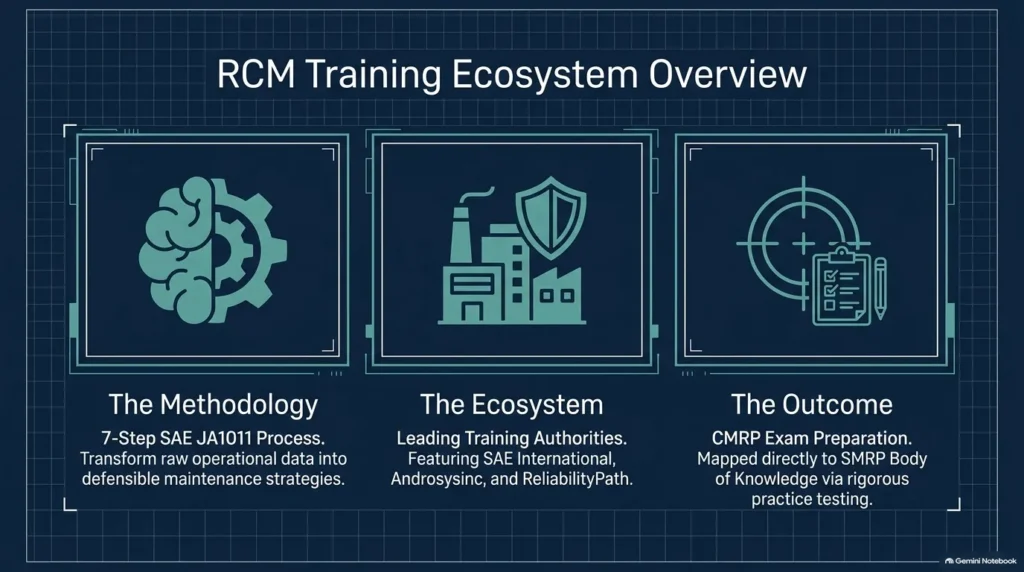
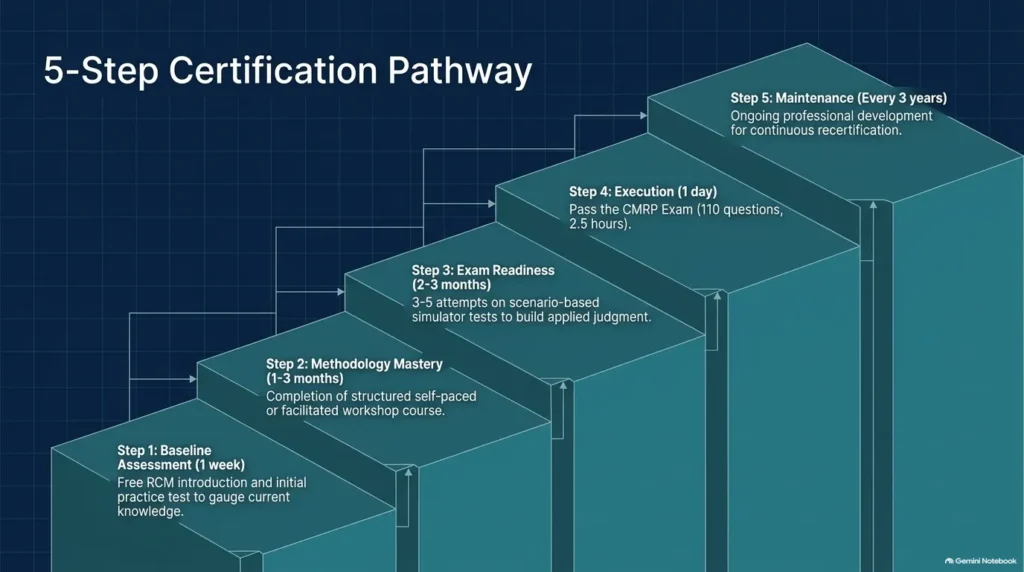
RCM training feeds directly into the CMRP certification path. Specifically, the SMRP Body of Knowledge includes RCM within its Equipment Reliability pillar, so RCM training is a natural preparation step. Furthermore, most successful CMRP candidates combine RCM training with scenario-based practice tests to build the applied judgment the exam rewards. Therefore, the path is: RCM training → practice tests → CMRP exam → recertification every 3 years.
| Step | Action | Timeline | Outcome |
|---|---|---|---|
| 1 | Free RCM introduction + practice test | 1 week | Baseline assessment |
| 2 | Self-paced or workshop RCM course | 1-3 months | Methodology mastery |
| 3 | Practice tests (3-5 attempts) | 2-3 months | Exam readiness |
| 4 | CMRP exam (110 questions, 2.5 hours) | 1 day | Certification earned |
| 5 | Recertification (professional development) | Every 3 years | Credential maintained |
Consequently, the full path from decision to certified takes 4-7 months for most professionals. Furthermore, the credential is valid for 3 years, after which recertification requires professional development tracking. Therefore, plan your timeline and budget accordingly. For the complete certification guide, see our RCM certification page.
What You Will Learn
Comprehensive RCM training covers the full 7-question methodology plus the supporting skills needed to apply it in practice. Furthermore, the table below summarizes the core modules and learning objectives.
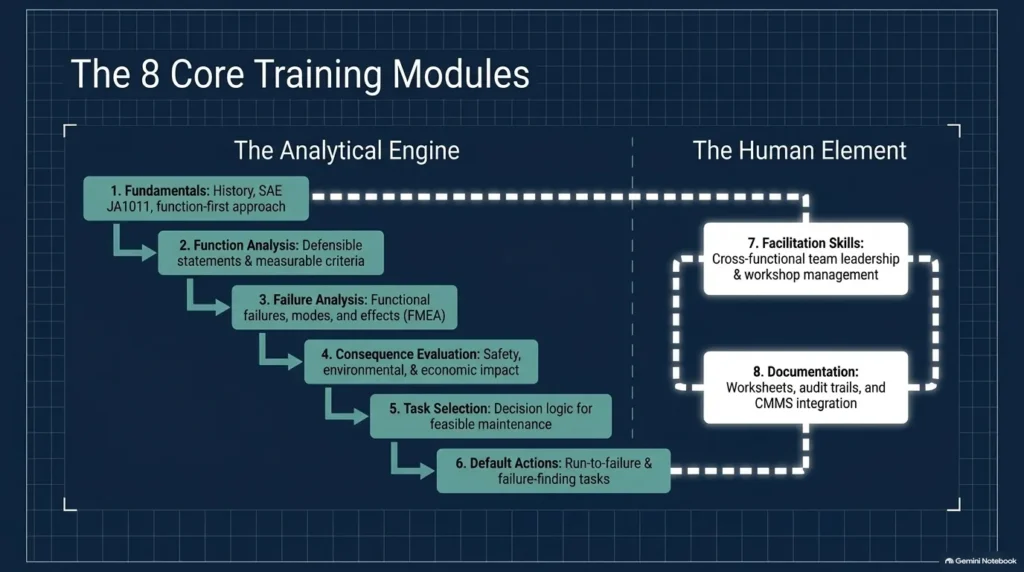
| Module | Topics Covered | Learning Objective |
|---|---|---|
| 1. RCM Fundamentals | History, SAE JA1011, the 7 questions, function-first approach | Explain RCM and its logical sequence |
| 2. Function Analysis | Function statements, performance standards, measurable criteria | Write defensible function statements |
| 3. Failure Analysis (FMEA) | Functional failures, failure modes, failure effects | Document failures per SAE JA1011 |
| 4. Consequence Evaluation | Safety, environmental, operational, economic classification | Classify consequences correctly |
| 5. Task Selection | RCM decision logic, technically feasible, worth doing | Select appropriate maintenance tasks |
| 6. Default Actions | Run-to-failure, redesign, failure-finding tasks | Assign default actions when no task exists |
| 7. Facilitation Skills | Cross-functional team leadership, workshop management | Lead an RCM analysis workshop |
| 8. Documentation & CMMS | Worksheets, audit trails, CMMS integration | Document and implement analyses |
Modules 1 through 6 cover the analytical methodology, while modules 7 and 8 cover the practical skills needed to lead analyses and implement results. Furthermore, facilitator-level training spends significant time on module 7 (facilitation skills), because the methodology is only as good as the team that applies it. Therefore, if you plan to lead RCM analyses, prioritize training that includes facilitation practice, not just theory. For hands-on examples, see our RCM example guide.
Course Structure & Duration
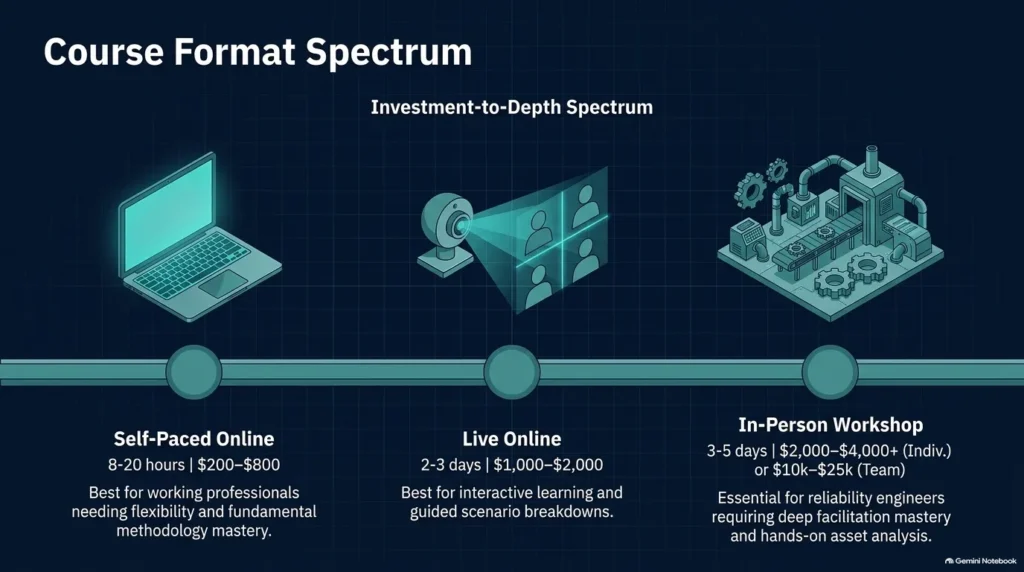
RCM training comes in several formats, each suited to different learning styles and budgets. Furthermore, the table below compares the common formats with their typical cost and duration.
| Format | Duration | Typical Cost | Best For |
|---|---|---|---|
| Free online introduction | 1-3 hours | $0 | Beginners, overview |
| Self-paced online course | 8-20 hours | $200-$800 | Working professionals |
| Live online workshop | 2-3 days | $1,000-$2,000 | Interactive learning |
| In-person facilitated workshop | 3-5 days | $2,000-$4,000+ | Facilitator training, hands-on |
| On-site corporate training | 3-5 days | $10,000-$25,000 (group) | Teams, custom content |
Choose a format that matches your learning style, budget, and career goals. Free online introductions are ideal for assessing whether RCM is right for you before investing in paid training. Moreover, self-paced online courses suit working professionals who need flexibility. Live and in-person workshops provide the interaction needed to master facilitation skills. Therefore, most professionals start with a free introduction, then progress to paid training once they commit to RCM.
Top RCM Training Providers
Several providers offer RCM training, ranging from SAE-approved courses to independent reliability consultancies. Furthermore, the table below compares leading RCM training providers by format, cost, and ideal audience.
| Provider | Format | Typical Cost | Best For |
|---|---|---|---|
| SAE International | In-person & online | $1,500-$3,000 | SAE JA1011 standard training |
| Androsysinc | Online & on-site | $1,000-$2,500 | Facilitator certification |
| RCM Academy | Online | $300-$1,200 | Self-paced learning |
| Meritt Global | Online & on-site | $1,000-$2,000 | Corporate training |
| PEMAC | Online | $800-$1,500 | CAMA-aligned training |
| ReliabilityPath | Online simulator | Free + $16 | Practice test & exam prep |
SAE International offers the most authoritative training because they publish the JA1011 and JA1012 standards. Furthermore, Androsysinc and RCM Academy specialize in RCM facilitator training, while PEMAC aligns training with the CAMA credential. Therefore, choose a provider based on your goals: SAE for standard-based depth, facilitator providers for leading analyses, and ReliabilityPath for exam preparation. For the complete course guide, see our RCM course resource.
Who Should Take This Training
RCM training is designed for professionals who perform, lead, or oversee maintenance strategy decisions. Furthermore, the table below identifies the roles that benefit most from RCM training.
| Role | Why RCM Training Helps | Recommended Level |
|---|---|---|
| Reliability engineer | Core methodology for reliability analysis | Facilitator-level |
| Maintenance manager | Optimize maintenance strategies across assets | Practitioner-level |
| Asset manager | Supports ISO 55000 asset management decisions | Practitioner-level |
| Maintenance planner | Understand why tasks are selected | Introduction |
| Operations manager | Understand maintenance-operations trade-offs | Introduction |
| Consultant | Advise clients on RCM implementation | Facilitator-level |
| Engineering graduate | Build reliability career foundation | Practitioner-level |
Reliability engineers and consultants benefit most from facilitator-level training, which equips them to lead RCM analyses with cross-functional teams. Furthermore, maintenance managers and asset managers benefit from practitioner-level training, which enables them to oversee and interpret analyses. Therefore, match the training level to your role and career trajectory. For the broader benefits, see our RCM benefits guide.
RCM Training Costs
The cost of RCM training varies by format and provider. Furthermore, the table below breaks down the typical cost components across RCM training formats, helping you budget accurately for the full certification journey.
| Cost Component | Self-Paced Online | Live Online | In-Person Workshop |
|---|---|---|---|
| Training tuition | $200-$800 | $1,000-$2,000 | $2,000-$4,000+ |
| Study materials | $50-$200 | Included | Included |
| Practice test (ReliabilityPath) | Free | Free | Free |
| Full simulator | $16 | $16 | $16 |
| Travel (if in-person) | $0 | $0 | $0-$1,500 |
| Certification exam (CMRP) | $250-$300 | $250-$300 | $250-$300 |
| Total (with exam) | $516-$1,316 | $1,266-$2,316 | $2,266-$5,816 |
The 3-year total cost ranges from $516 (self-paced, with exam) to $5,816 (in-person, with travel and exam). Furthermore, the self-paced path is the most affordable, while in-person workshops add travel costs but provide the deepest facilitation practice. Therefore, balance cost against the depth of skills you need.
RCM Training ROI
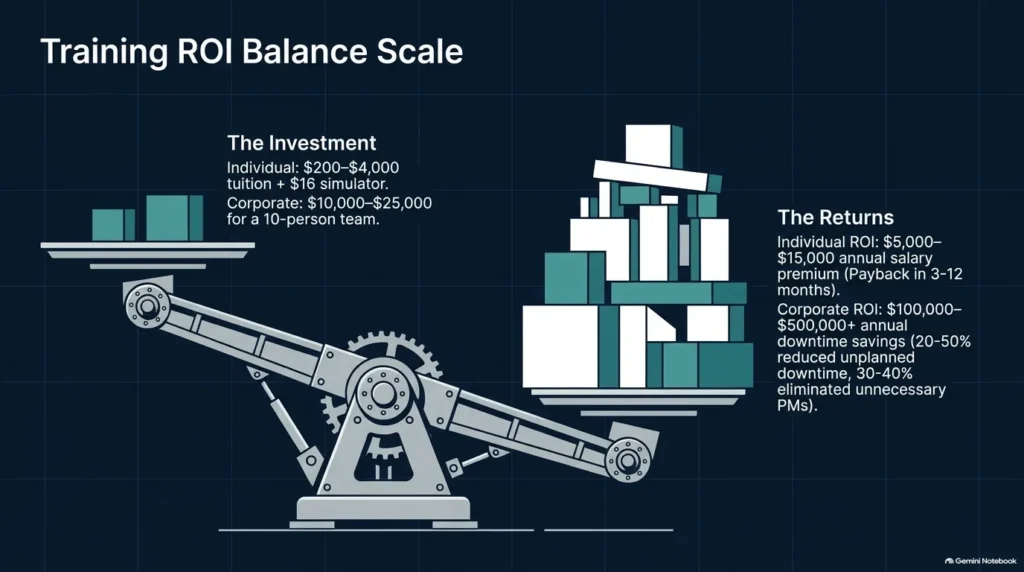
The ROI of RCM training is compelling. Specifically, a $200-$800 self-paced course plus a $16 practice simulator can unlock a $5,000-$15,000 annual salary premium for CMRP-certified professionals. Furthermore, organizations that train their teams in RCM report 20-50% reduced unplanned downtime and 30-40% eliminated unnecessary PMs. Therefore, the training investment pays for itself within months — both for individuals and for organizations.
| Investment | Individual | Organization (10-person team) |
|---|---|---|
| Training cost | $200-$4,000 | $10,000-$25,000 |
| Practice simulator | $16 | $160 |
| Annual salary premium | $5,000-$15,000 | — |
| Annual downtime savings | — | $100,000-$500,000+ |
| Payback period | 3-12 months | 1-6 months |
Consequently, the ROI is strongest for organizations that train entire teams. A $10,000-$25,000 investment in on-site training can return $100,000-$500,000+ in downtime savings within the first year. Therefore, RCM training is one of the highest-ROI investments an asset-intensive organization can make.
RCM Training Examples by Role
Different roles apply RCM training in different ways. Furthermore, the table below shows how three common roles use their RCM training in practice.
| Role | How They Use RCM Training | Training Level |
|---|---|---|
| Reliability engineer | Leads RCM analyses, selects maintenance tasks, documents decisions | Facilitator |
| Maintenance manager | Reviews RCM analyses, approves task changes, manages implementation | Practitioner |
| Operations manager | Understands why tasks exist, supports cross-functional workshops | Introduction |
How to Prepare for Certification
If your RCM training is preparation for the CMRP certification exam, a structured study plan accelerates success. Furthermore, the 5-step plan below ensures efficient preparation.
Step 1: Study the Body of Knowledge
Review the SMRP Body of Knowledge, which includes RCM within the Equipment Reliability pillar. Furthermore, study the ISO 55000 standards and SAE JA1011 to understand the methodology’s foundation. Therefore, start with theory before practicing application.
Step 2: Take Practice Tests
Use scenario-based practice tests to build applied judgment. Specifically, our free RCM practice test provides 20 questions with instant scoring. Furthermore, the full simulator ($16) offers unlimited attempts and detailed explanations. Practice tests reveal your weak areas before the real exam.
Step 3: Target Weak Areas
Use practice test results to identify your weakest pillars, then focus study on those areas. Furthermore, most candidates need 3-5 timed attempts before scores stabilize above the ~70% pass mark. Therefore, treat each attempt as a diagnostic, not just a score.
Step 4: Complete Structured Training
If you have not already, complete a structured RCM training course to build the applied judgment the exam rewards. Moreover, training that includes hands-on analysis of real assets is more effective than theory-only courses. For options, see our RCM course guide.
Step 5: Final Review & Schedule
In the final 3-4 weeks, take 2-3 full timed practice tests to build stamina, then schedule your exam. Furthermore, the CMRP exam is 110 questions in 2.5 hours, so timed practice is essential. For the full certification path, see our RCM certification guide.

Frequently Asked Questions
These questions answer the most common searches about RCM training. For the full set of certification questions, see our FAQs hub.
What is reliability centered maintenance training?
RCM training teaches the 7-step method in SAE JA1011. It covers asset functions, failure modes, and task selection. Training ranges from free online intros to multi-day workshops. Pick the level that fits your role. Beginners start with an intro. Leaders need facilitator-level training.
How much does RCM training cost?
RCM training costs range from free to $4,000+. Self-paced online courses cost $200-$800. Live online workshops run $1,000-$2,000. On-site corporate training costs $10,000-$25,000 per group. Start with a free intro. Invest in paid training once you commit to RCM.
Are there free RCM training courses online?
Yes. Free RCM training online includes intro videos, articles, and practice tests. Our free RCM practice test gives 20 questions with instant scoring. It helps you test the waters before you pay. Free courses cover only the basics. For facilitator skills, paid training is best.
How long does RCM training take?
RCM training takes 1-3 hours for free intros. It takes 8-20 hours for self-paced online courses. Facilitated workshops run 3-5 days. Plan your time based on your goals. A few hours gives an overview. A few days builds facilitator skill. After training, plan 3-6 months of study for the CMRP exam.
Which RCM training provider is best?
The best provider depends on your goals. SAE International offers the most authoritative training. They publish the JA1011 and JA1012 standards. Androsysinc and RCM Academy focus on facilitator training. PEMAC aligns training with the CAMA credential. Choose SAE for depth. Choose facilitator providers to lead analyses. Choose ReliabilityPath for exam prep.
What is the difference between RCM training and RCM certification?
RCM training teaches the method. RCM certification proves you master it. Training covers the 7 SAE JA1011 questions and facilitation skills. Certification (the CMRP by SMRP) checks your skill through a 110-question exam. Training is the prep path. Certification is the proof. See our RCM certification page for the full guide.
Can I get RCM training online?
Yes. You can take RCM training fully online. Self-paced courses, live online workshops, and practice tests all work online. The CMRP exam itself runs at authorized testing centers. But your prep can happen from anywhere. Our free practice test and full simulator ($16) support online study.
Does RCM training lead to a salary increase?
Yes. RCM training leads to the CMRP credential. CMRP holders earn $90,000-$130,000+ per year. That is a $5,000-$15,000 premium over peers without the credential. The training cost pays off fast. Most pros earn it back within the first year. See our CMRP salary guide for the full breakdown.
What is the best RCM training for beginners?
The best RCM training for beginners is a free online introduction plus a practice test. This combo lets you learn the 7 questions and test your grasp before you pay. Our free RCM practice test is a great start. It gives 20 questions and instant scores. Once you feel ready, move to a paid self-paced course. That path builds skill at low risk and low cost.
Ready to Start RCM Training?
RCM training is the foundation of a reliability career — it teaches the methodology that drives defensible, consequence-driven maintenance decisions. Furthermore, the right training depends on your role, budget, and career goals. To assess your baseline before committing to paid training, take our free RCM practice test with 20 questions and instant scoring. Then explore our RCM course guide for the complete training ecosystem. For the methodology itself, read our reliability centered maintenance guide and the RCM analysis resource. For certification, see the RCM certification guide. For the benefits, see the RCM benefits guide. When you are ready, view all exam simulators and take the next step.
ReliabilityPath builds exam simulators for CMRP, CAMA, and RCM certifications, grounded in the SAE JA1011/JA1012 standards and the SMRP Body of Knowledge.