



Reliability centered maintenance (RCM) is a structured methodology defined in SAE JA1011 that determines optimal maintenance strategies by answering 7 fundamental questions about each asset’s functions, failure modes, and consequences. Furthermore, RCM is consequence-driven rather than asset-driven — meaning identical equipment can receive different maintenance strategies based on what happens when it fails in its specific operating context. This guide covers the complete RCM methodology, the 7 questions, core principles, benefits, implementation, and how RCM compares to preventive maintenance.
Table of Contents
What Is Reliability Centered Maintenance?
Reliability centered maintenance (RCM) is a structured methodology defined in SAE JA1011 that determines optimal maintenance strategies by answering 7 fundamental questions about each asset’s functions, failure modes, and consequences. Furthermore, RCM was originally developed in the 1960s for the commercial aviation industry, where it revolutionized maintenance of the Boeing 747 by shifting from schedule-driven to consequence-driven decision-making. Moreover, the methodology was codified in SAE JA1011 in 1999, with implementation guidance in the companion standard SAE JA1012.
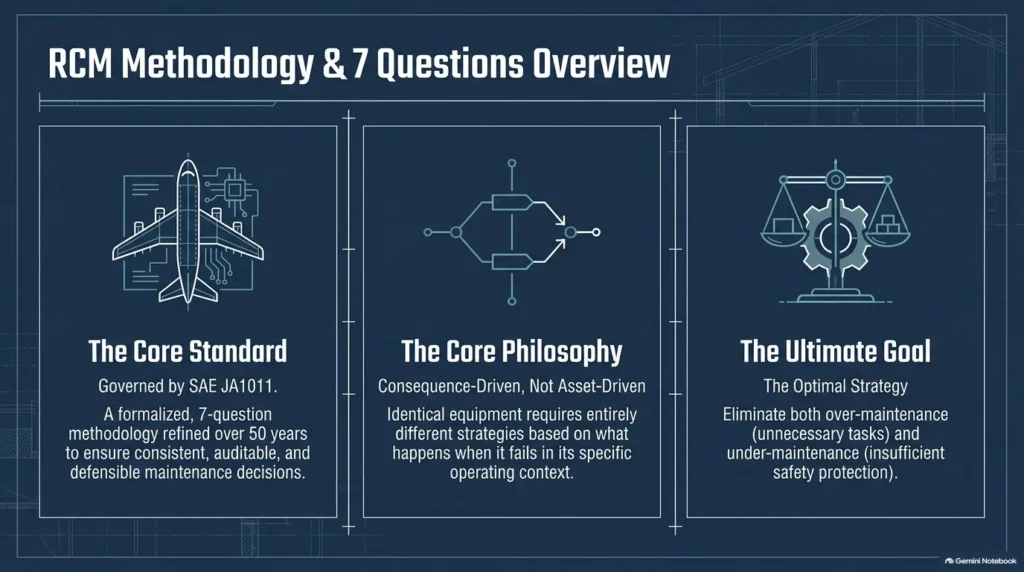
Specifically, the defining characteristic of RCM is its function-first, consequence-driven approach. Instead of asking “how do we maintain this pump?”, RCM asks “what functions must this pump perform, and what happens if it fails to perform them?” This shift in perspective is what allows RCM to justify aggressive condition monitoring on a safety-critical pump while allowing an identical pump in a non-critical role to run to failure. Therefore, RCM is not about the equipment — it is about the consequences of failure in context. For the complete analysis process, see our RCM analysis guide.
RCM History and Evolution
The table below summarizes the key milestones in RCM’s evolution from aviation to industrial standard.
| Decade | Milestone | Impact |
|---|---|---|
| 1960s | FAA/airline industry develops RCM for Boeing 747 | Shift from schedule-driven to consequence-driven |
| 1978 | Nowlan & Heap publish “Reliability-Centered Maintenance” | First formal RCM framework |
| 1990s | John Moubray publishes “RCM II” | Industrial adaptation and popularization |
| 1999 | SAE publishes JA1011 standard | Formal definition of RCM requirements |
| 2012 | SAE publishes JA1012 implementation guidance | Practical implementation standard |
| 2010s-2020s | Integration with ISO 55000 asset management | RCM as foundation for asset management systems |
Furthermore, this evolution explains why RCM is now applied well beyond aviation — in oil and gas, chemicals, power generation, manufacturing, pharmaceuticals, and mining. Moreover, the integration with ISO 55000 has positioned RCM as the analytical methodology that supports asset management system certification worldwide. Consequently, professionals who master RCM are well-positioned for careers that span multiple asset-intensive industries, and the methodology itself continues to evolve as condition monitoring, IoT sensors, and predictive analytics extend what RCM can achieve.
In addition, RCM is governed by SAE JA1011, which defines the 7 questions that any RCM process must answer. Furthermore, the standard ensures that RCM analyses are consistent, auditable, and defensible — critical for regulated industries and safety-critical assets. Consequently, any analysis that does not answer all 7 questions cannot claim to be true RCM. For a general overview, see Reliability-Centered Maintenance on Wikipedia. For the broader asset management standard, see ISO 55000.
Core Principles: The 7 Questions
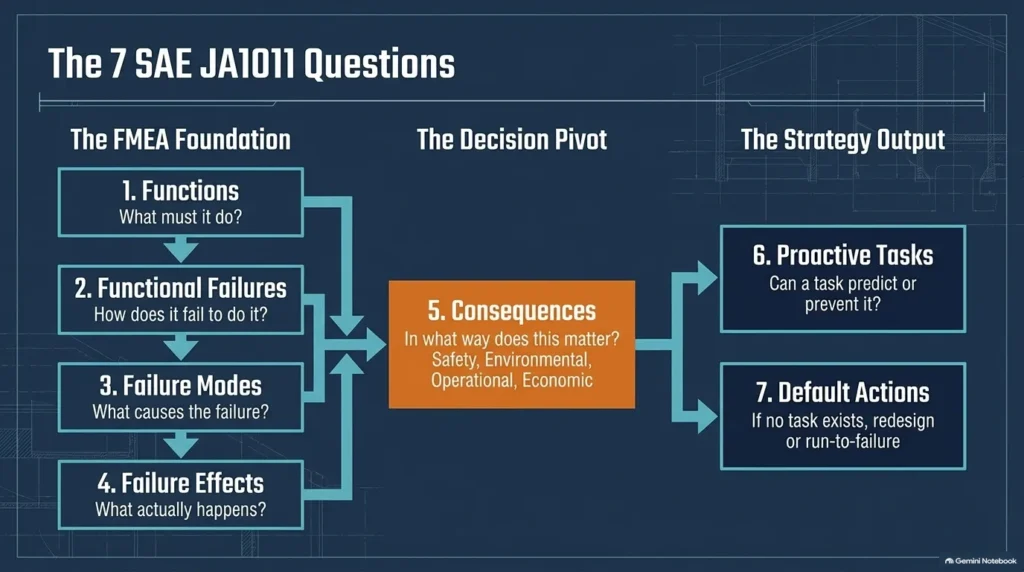
Every legitimate RCM analysis answers 7 fundamental questions, defined in SAE JA1011. Furthermore, the questions build on each other sequentially: you cannot select a maintenance task until you understand the failure consequences, and you cannot understand consequences until you understand the failure modes. The table below summarizes all 7 questions with their outputs.
| Question # | Question | Output |
|---|---|---|
| 1 | What are the functions and performance standards? | Function statements |
| 2 | In what ways can it fail to fulfill those functions? | Functional failures |
| 3 | What causes each functional failure? | Failure modes |
| 4 | What happens when each failure occurs? | Failure effects |
| 5 | In what way does each failure matter? | Failure consequences (safety, operational, economic) |
| 6 | What proactive task can predict or prevent each failure? | Selected maintenance tasks (CBM, PM, replacement) |
| 7 | What if no suitable proactive task can be found? | Default strategies (run-to-failure, redesign) |
Specifically, questions 1 through 4 form the FMEA (Failure Mode and Effects Analysis) portion — they document what can go wrong and what happens when it does. Furthermore, question 5 is the decision pivot that classifies consequences as safety/environmental, operational, or non-operational. Moreover, questions 6 and 7 select the maintenance tasks using the RCM decision logic. Therefore, the 7 questions are not merely a checklist — they represent a logical decision tree refined over 50 years of industrial practice. For the foundational analysis guide, see our RCM analysis resource.
How RCM Works (Process)
While the 7 questions define what must be answered, the RCM process defines how to answer them systematically. Furthermore, the process consists of 8 sequential steps, each building on the previous. Skipping any step risks an incomplete or invalid analysis.
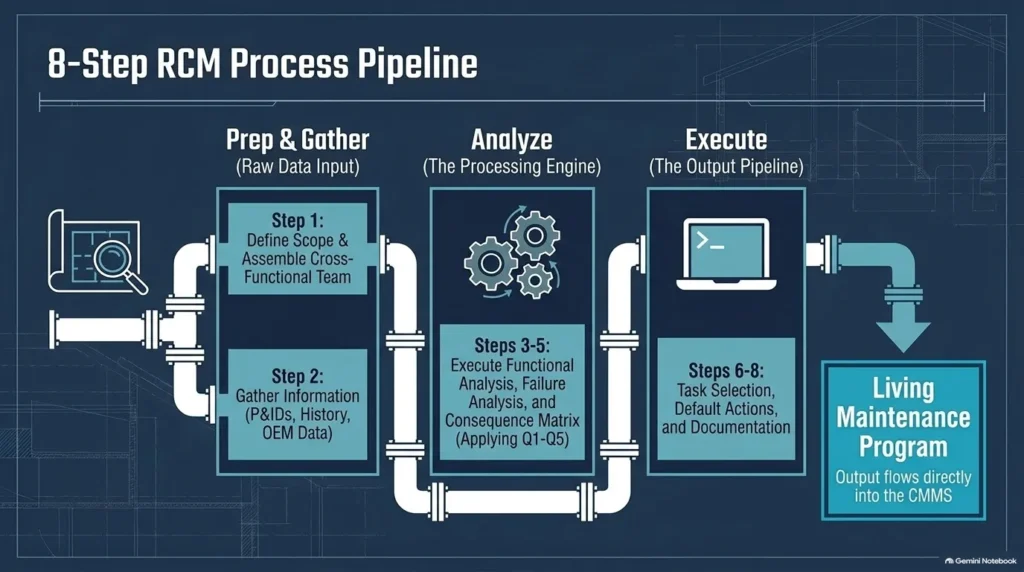
| Step | Name | Key Activities | Output |
|---|---|---|---|
| 1 | Preparation & Scope | Define system boundaries, select assets, assemble team | Scope document, team roles |
| 2 | Information Gathering | Collect P&IDs, maintenance history, OEM manuals | Asset dossiers, failure history |
| 3 | Functional Analysis | Define functions and performance standards (Q1) | Function statements |
| 4 | Failure Analysis | Identify functional failures and failure modes (Q2-3) | Failure mode list |
| 5 | Effects & Consequences | Document effects and classify consequences (Q4-5) | Consequence matrix |
| 6 | Task Selection | Apply RCM decision logic to select tasks (Q6) | Maintenance task list |
| 7 | Default Actions | Assign run-to-failure or redesign where no task exists (Q7) | Default action log |
| 8 | Documentation & Implementation | Compile worksheet, update CMMS, train technicians | Living maintenance program |
Furthermore, RCM analysis should be facilitated by someone trained in the methodology. Specifically, the best results come from cross-functional teams that include operations (who know how the asset is used), maintenance (who know how it fails), and engineering (who know the design intent). Therefore, plan for 2-3 days of facilitated workshops for a typical system analysis. For a worked example, see our RCM example guide.
RCM Benefits
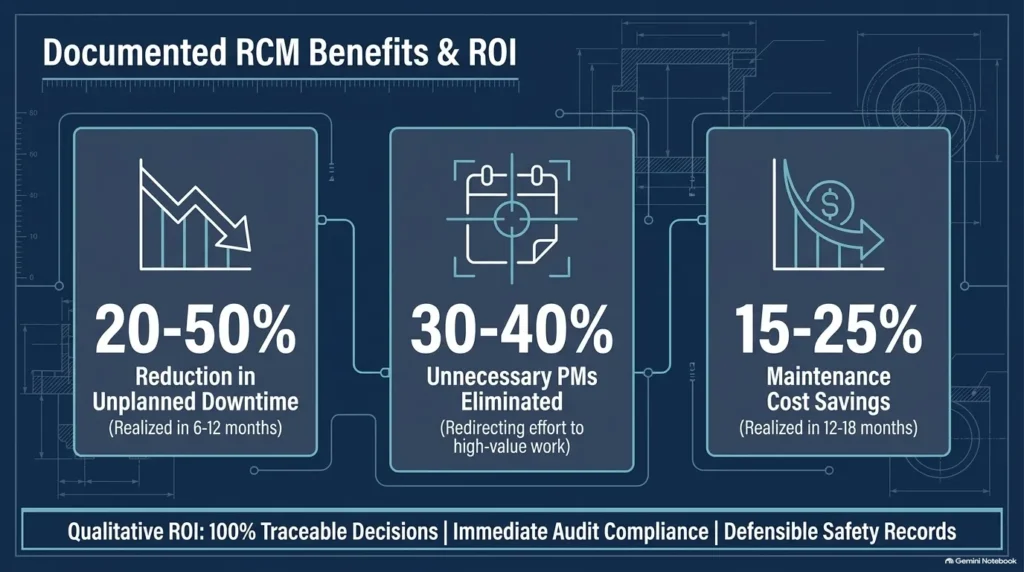
RCM delivers measurable benefits across reliability, cost, safety, and compliance. Furthermore, the table below summarizes the documented benefits with their typical improvement ranges.
| Benefit | Typical Improvement | Time to Realize |
|---|---|---|
| Reduced unplanned downtime | 20-50% | 6-12 months |
| Eliminated unnecessary PMs | 30-40% | 3-6 months |
| Maintenance cost reduction | 15-25% | 12-18 months |
| Improved asset availability | 5-15% | 6-12 months |
| Fewer safety incidents | 10-30% | 12-24 months |
| Defensible maintenance decisions | 100% traceable | Immediate |
| Faster audit compliance | 50-70% faster | Immediate |
Consequently, the most immediate benefit is the elimination of unnecessary preventive maintenance tasks. Furthermore, many organizations discover that 30-40% of their scheduled PMs address failures that either never occur or have no meaningful consequence. Therefore, RCM identifies these tasks and allows teams to redirect that effort to higher-value work. For the full benefits analysis, see our RCM benefits guide.
RCM Implementation
Implementing RCM requires a structured approach that translates the methodology into measurable results. Furthermore, the 5-step implementation path below ensures the analysis delivers value.
Step 1: Prioritize Assets by Criticality
Rank your assets by the consequence of their failure — safety, environmental, operational, and economic. Furthermore, focus your first RCM analyses on the top 10-20% most critical assets. Therefore, you capture the highest-value benefits before scaling to less critical equipment.
Step 2: Assemble a Cross-Functional Team
RCM analysis requires perspectives from operations, maintenance, and engineering. Specifically, a single analyst cannot capture all perspectives effectively. Therefore, schedule 2-3 day facilitated workshops with representatives from each function.
Step 3: Perform the 7-Question Analysis
Walk through all 7 SAE JA1011 questions for each asset. Furthermore, document functions, failure modes, effects, consequences, and selected tasks in a structured worksheet — either RCM software or an Excel template. For the complete methodology, see our RCM analysis guide.
Step 4: Implement Selected Tasks
Transfer RCM-selected tasks into your CMMS as scheduled work orders. Furthermore, eliminate the unnecessary PMs identified by the analysis. Moreover, ensure condition-based tasks integrate with your condition monitoring program. For foundational training, see our RCM training and RCM course guides.
Step 5: Review & Sustain
RCM is a living program. Furthermore, review analyses annually for safety-critical systems and biennially for non-critical assets. Therefore, the benefits compound over time as the program matures. For certification, see our RCM certification guide.
RCM vs Preventive Maintenance
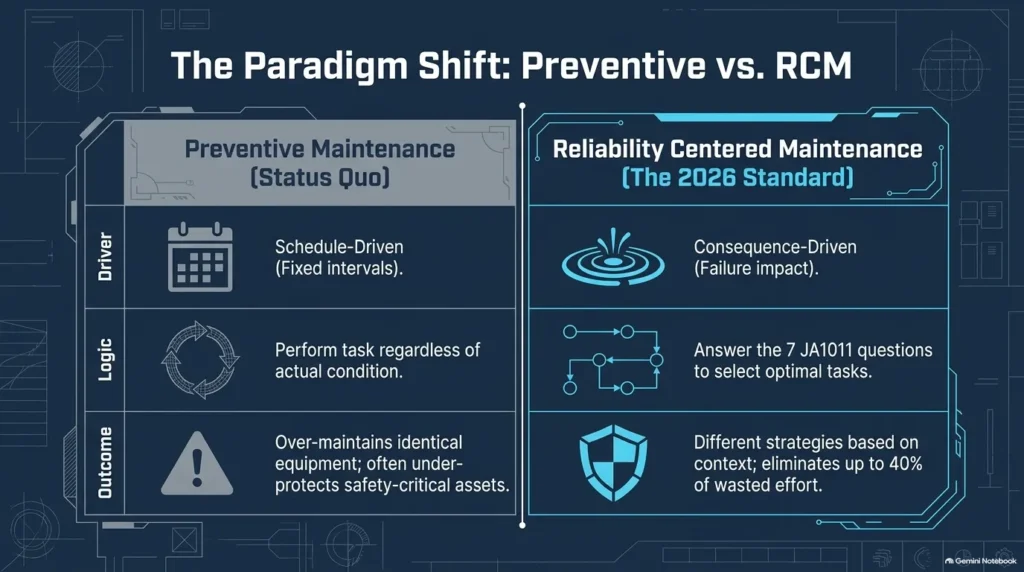
A common question is how RCM differs from preventive maintenance (PM). Furthermore, the table below compares the two approaches across key dimensions.
| Dimension | Preventive Maintenance (PM) | Reliability Centered Maintenance (RCM) |
|---|---|---|
| Driver | Schedule (fixed intervals) | Consequence (failure impact) |
| Logic | Perform task at interval regardless of condition | Answer 7 questions to select task based on consequence |
| Identical equipment | Same strategy for all | Different strategy based on operating context |
| Unnecessary PMs | Often over-maintains | Eliminates 30-40% of unnecessary PMs |
| Safety-critical assets | May under-protect | Ensures appropriate tasks for safety consequences |
| Non-critical assets | May over-maintain | Allows run-to-failure when justified |
| Audit trail | Limited | Full traceability from failure mode to task |
| Standard | Various | SAE JA1011 / JA1012 |
Specifically, the key difference is that PM is schedule-driven while RCM is consequence-driven. Furthermore, PM applies the same strategy to identical equipment, while RCM can apply different strategies based on what happens when each asset fails. Consequently, RCM eliminates both over-maintenance (unnecessary PMs on non-critical assets) and under-maintenance (insufficient tasks on safety-critical assets). Therefore, RCM optimizes the maintenance program in ways that PM cannot. For a worked example of consequence-driven decision-making, see our RCM example guide.
Frequently Asked Questions
These questions address the most common searches around reliability centered maintenance, including all PAA questions. For the full set of reliability questions, see our FAQs hub.
What is reliability-centered maintenance?
Reliability-centered maintenance (RCM) is a structured methodology defined in SAE JA1011 that determines optimal maintenance strategies by answering 7 fundamental questions about each asset’s functions, failure modes, and consequences. Furthermore, RCM is consequence-driven rather than asset-driven, meaning identical equipment can receive different maintenance strategies based on the consequences of their failure in context. Therefore, RCM is not about the equipment — it is about what happens when the equipment fails in its specific operating context.
What are the 7 questions of RCM?
The 7 questions of RCM are: (1) What are the functions and performance standards? (2) In what ways can it fail to fulfill those functions? (3) What causes each functional failure? (4) What happens when each failure occurs? (5) In what way does each failure matter? (6) What proactive task can predict or prevent each failure? (7) What should be done if no suitable proactive task can be found? Furthermore, these questions, defined in SAE JA1011, form the complete RCM analysis process. For the full breakdown, see our RCM analysis guide.
What is the difference between preventive maintenance and reliability-centered maintenance?
Preventive maintenance (PM) is schedule-driven: tasks are performed at fixed intervals regardless of actual condition or consequence. Specifically, reliability-centered maintenance (RCM) is consequence-driven: tasks are selected based on the 7 SAE JA1011 questions, which evaluate what happens when an asset fails. Furthermore, PM applies the same strategy to identical equipment; RCM can apply different strategies to identical equipment based on failure consequences in context. Therefore, RCM eliminates both over-maintenance and under-maintenance in ways that PM cannot.
What is the reliability-centered maintenance golden rule?
The reliability-centered maintenance golden rule is that every selected maintenance task must be both technically feasible and worth doing. Specifically, technically feasible means the task can predict or prevent the failure; worth doing means the task cost is justified by the failure consequence it addresses. Therefore, a task that fails either criterion should not be performed — this rule prevents both over-maintenance and under-maintenance. For more on the golden rule, see our RCM benefits guide.
Where can I find a reliability centered maintenance PDF?
Reliability centered maintenance PDFs are available from SAE (the JA1011 and JA1012 standards), training providers, and within our RCM analysis guide. Furthermore, our guide walks through all 7 questions with consequence evaluation and task selection — the same structure used in professional RCM worksheets. Therefore, use our guide as a template for your own analyses. For the Excel template equivalent, see our RCM software guide.
What is the best reliability centered maintenance book?
The most authoritative RCM book is “Reliability-Centered Maintenance” by John Moubray, which is the recognized reference text for the methodology. Furthermore, the SAE JA1011 and JA1012 standards provide the formal definition and implementation guidance. Therefore, for a complete understanding, read Moubray’s book alongside the SAE standards. For training options, see our RCM training guide.
How is RCM related to ISO 55000?
RCM is the methodology that provides the analytical foundation for ISO 55000 asset management. Specifically, ISO 55000 requires organizations to demonstrate risk-based, consequence-driven maintenance decision-making — and RCM is the recognized methodology that delivers this. Furthermore, RCM provides the audit trail that ISO 55001 assessors look for: every maintenance task traceable back to a failure mode and consequence. Therefore, RCM and ISO 55000 are complementary, not competing.
Ready to Master RCM?
Reliability centered maintenance is the methodology that transforms maintenance from a schedule-driven activity into a consequence-driven strategy. Furthermore, it delivers measurable benefits — reduced downtime, lower costs, fewer safety incidents, and defensible maintenance decisions. To build the skills needed to lead RCM analyses, start with a free RCM practice test to assess your baseline. Then explore our RCM training and RCM course guides. For the complete analysis process, read our RCM analysis guide. For the benefits, see the RCM benefits resource. For examples, see the RCM example guide. For software, see the RCM software guide. For certification, see the RCM certification guide. When you are ready, view all exam simulators and take the next step.
ReliabilityPath builds exam simulators for CMRP, CAMA, and RCM certifications, grounded in the SAE JA1011/JA1012 standards and the SMRP Body of Knowledge.