



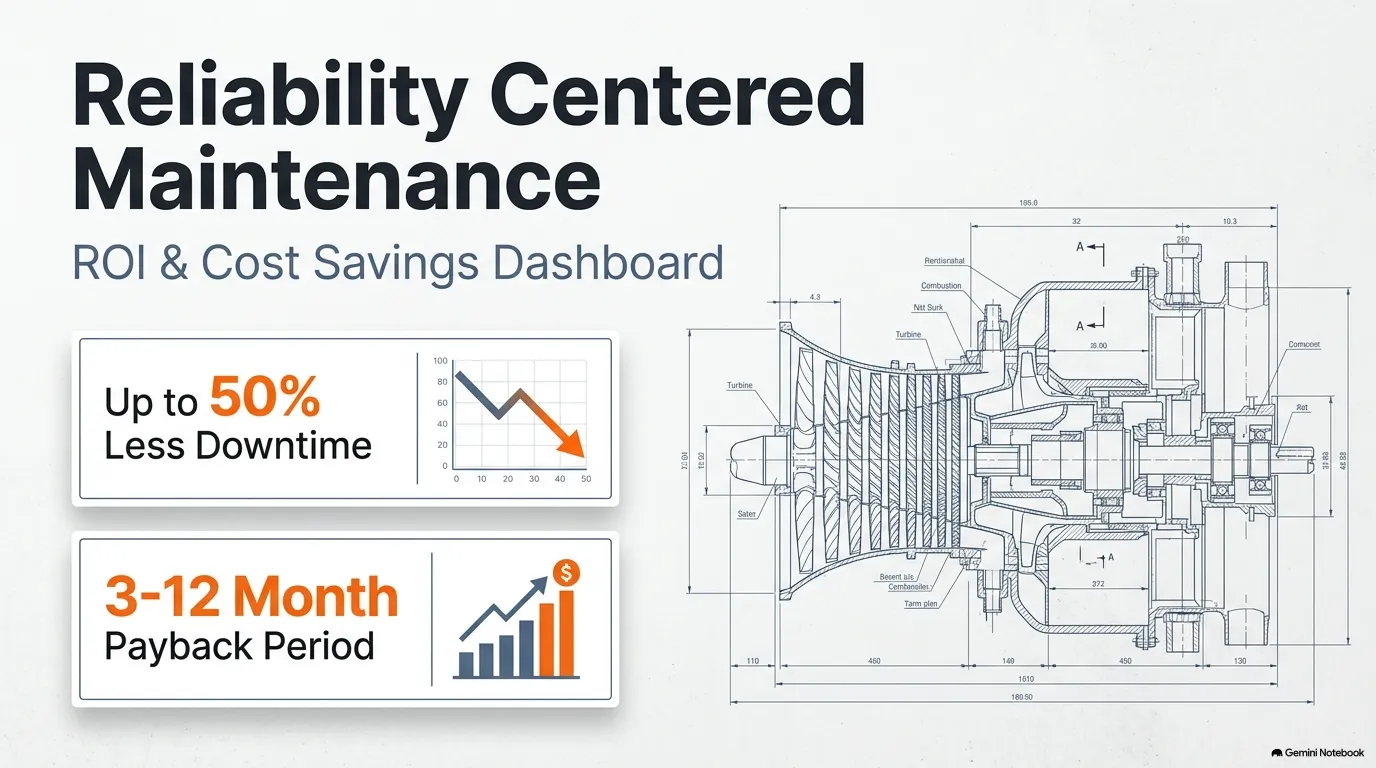
Reliability centered maintenance benefits include 20-50% less unplanned downtime. They also cut maintenance costs by 15-25%. Furthermore, RCM removes 30-40% of needless preventive maintenance tasks. RCM does this by shifting from schedule-driven to consequence-driven maintenance. It targets effort where it matters most. This guide covers the 10 proven RCM benefits with metrics. It also covers the business impact, who gains most, and how to get results in your plant.
Table of Contents
- 10 Key Benefits of RCM
- Business Impact (ROI, Cost, Safety)
- Quantifiable Results & Benchmarks
- Who Benefits Most from RCM?
- How to Realize These Benefits
- Disadvantages & Limitations of RCM
- Frequently Asked Questions
- Ready to Realize RCM Benefits?
10 Key Benefits of RCM
Reliability centered maintenance delivers measurable benefits across reliability, cost, safety, and compliance. Furthermore, these benefits are documented across decades of industrial deployment in oil and gas, chemicals, power generation, aerospace, and manufacturing. The table below summarizes the 10 key benefits with their typical improvement ranges.
| # | Benefit | Typical Improvement | Time to Realize |
|---|---|---|---|
| 1 | Reduced unplanned downtime | 20-50% | 6-12 months |
| 2 | Maintenance cost reduction | 15-25% | 12-18 months |
| 3 | Eliminated unnecessary PMs | 30-40% | 3-6 months |
| 4 | Improved asset availability | 5-15% | 6-12 months |
| 5 | Fewer safety incidents | 10-30% | 12-24 months |
| 6 | Extended asset life | 10-20% | 24-36 months |
| 7 | Defensible maintenance decisions | 100% traceable | Immediate |
| 8 | Faster audit compliance | 50-70% faster | Immediate |
| 9 | Better spare parts management | 15-30% inventory reduction | 6-12 months |
| 10 | Cultural shift to reliability | Qualitative | 12-24 months |
Furthermore, the most immediate benefit is the elimination of needless PM tasks. Many firms find that 30-40% of their scheduled PMs fix failures that never occur or have no real impact. Specifically, RCM flags these tasks. It lets teams move that effort to higher-value work. Consequently, this benefit often pays for the RCM analysis within the first year.
Moreover, the defensible decision benefit is unique to RCM. When auditors ask “why do you check this bearing quarterly?”, RCM gives a clear, traceable chain from failure mode to task. Therefore, RCM is vital for regulated industries. Oil and gas, nuclear, aerospace, and pharma all need defensible maintenance decisions. For the foundational method, see our reliability centered maintenance guide.
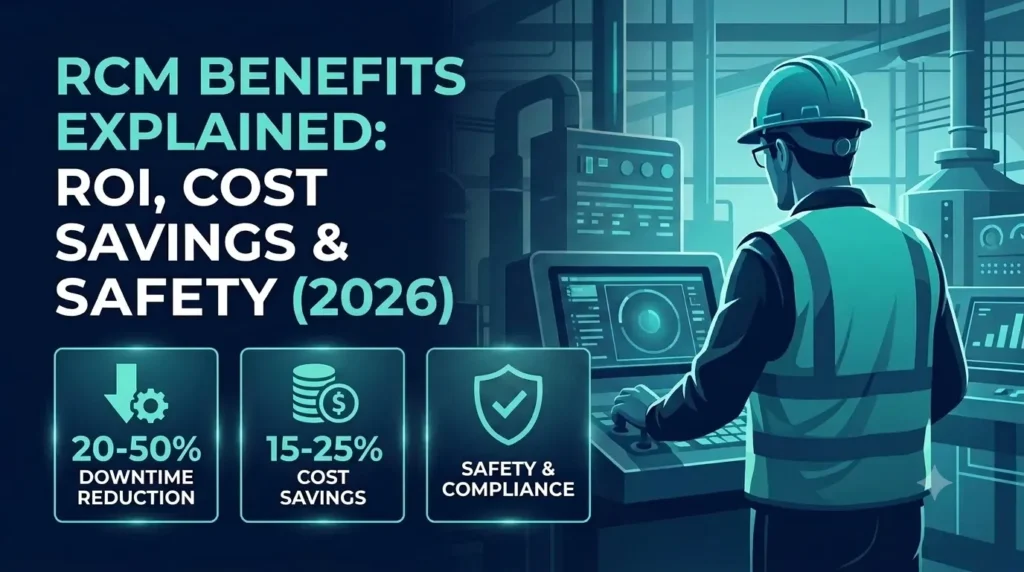
Video: RCM Benefits Explained — ROI, Cost Savings, and Safety (2026)
Business Impact (ROI, Cost, Safety)
The business impact of RCM goes beyond maintenance metrics. It reaches plant-wide operational and financial results. Furthermore, the table below maps RCM benefits to business outcomes that leaders and finance teams can assess.
| RCM Benefit | Business Outcome | Financial Impact (typical) |
|---|---|---|
| 20-50% less downtime | Higher production output | $100k-$1M+/year per critical asset |
| 15-25% lower maintenance cost | Reduced operating expense | $50k-$500k/year per plant |
| 30-40% fewer unnecessary PMs | Redirected labor to high-value work | 1-3 FTE equivalent per plant |
| 5-15% higher availability | Increased revenue capacity | Proportional to production value |
| 10-30% fewer safety incidents | Lower insurance, fewer fines | $10k-$100k+ per avoided incident |
| Faster audits | Reduced compliance overhead | 2-4 weeks of audit time saved |
| Extended asset life | Deferred capital replacement | $50k-$500k per deferred replacement |
Specifically, the ROI of RCM is strong. A typical plant invests $50,000-$150,000 in RCM analysis and setup. It can expect $200,000-$1,000,000+ in annual benefits. That is a payback of 3-12 months. Therefore, RCM is one of the best-ROI investments a maintenance team can make. Moreover, the benefits grow over time as the program matures and catches more failure modes.
In addition, the safety impact of RCM is often missed. By checking failure risks one by one, RCM makes sure safety-critical failures get the right tasks. Non-critical failures can run to failure. Consequently, RCM puts safety resources where they matter most. It does not spread them thin across all gear. For a worked example, see our RCM example guide.
Quantifiable Results & Benchmarks
The benefits above are not theory. They span decades of industrial use. Furthermore, the table below shows specific, measured results from published case studies.
| Industry | Organization Type | Result | Source/Context |
|---|---|---|---|
| Oil & gas | Major refinery | 40% reduction in unplanned downtime over 18 months | RCM on critical rotating equipment |
| Power generation | Nuclear plant | 50% reduction in unnecessary PMs | RCM on safety-related systems |
| Chemicals | Petrochemical complex | 25% maintenance cost reduction in year 2 | Full RCM program across 200 assets |
| Aerospace | Commercial airline | 30% fewer unscheduled removals | RCM on aircraft systems |
| Manufacturing | Automotive plant | 15% availability increase | RCM on production lines |
| Pharmaceuticals | API plant | 70% faster regulatory audits | RCM audit trail for FDA compliance |
| Mining | Open-pit operation | 20% extended haul truck life | RCM on mobile equipment |
Consequently, these results show that RCM benefits are steady across industries. The method transfers because it is consequence-driven, not industry-specific. Moreover, the results scale. A small plant with 50 critical assets can gain the same proportional benefits as a major refinery with 5,000 assets. Therefore, RCM is not just for big firms. It helps any operation where asset failure has real impact.
Who Benefits Most from RCM?
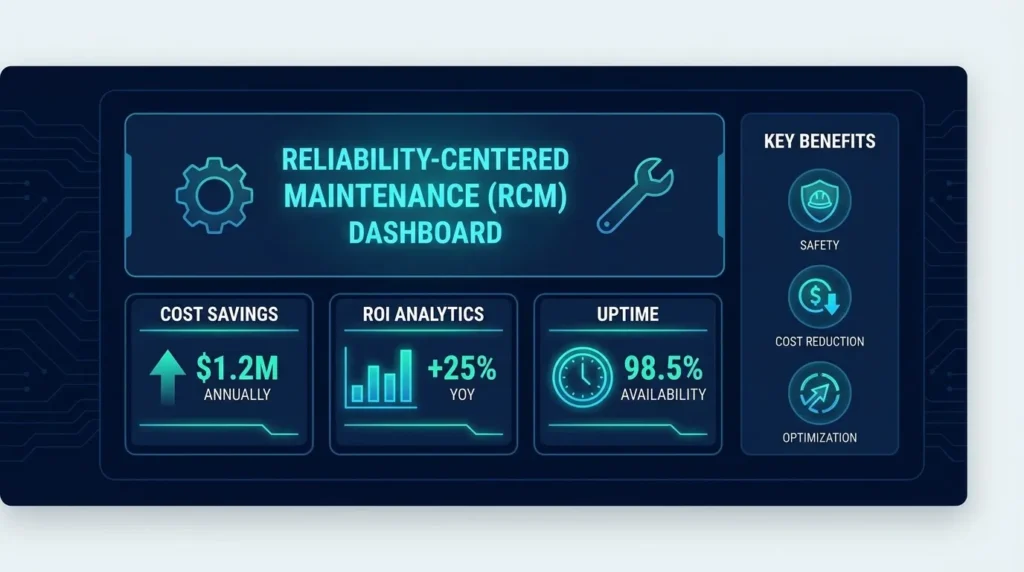
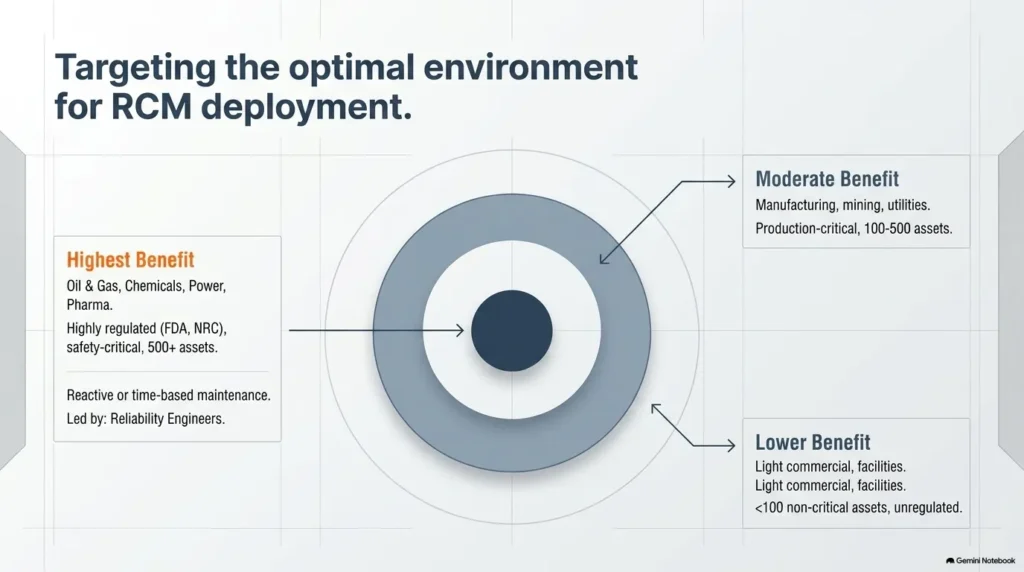
RCM benefits are not uniform across all firms. Furthermore, the table below shows which industries, roles, and org types gain the most from RCM.
| Dimension | Highest Benefit | Moderate Benefit | Lower Benefit |
|---|---|---|---|
| Industry | Oil & gas, chemicals, power, aerospace, pharma | Manufacturing, mining, utilities | Facilities, light commercial |
| Asset criticality | Safety-critical, high-value, regulated | Production-critical | Non-critical, redundant |
| Organization size | 500+ critical assets | 100-500 assets | <100 assets |
| Maintenance maturity | Reactive or time-based PM | Mixed PM + some CBM | Already mature predictive program |
| Regulatory environment | Highly regulated (FDA, NRC, FAA) | Moderately regulated | Unregulated |
| Role | Reliability engineers, maintenance managers, asset managers | Operations managers, plant managers | Technicians (indirect benefit) |
Specifically, the highest benefit goes to firms with safety-critical or regulated assets that still use reactive or time-based maintenance. For these firms, RCM gives a clear method to shift to consequence-driven maintenance while meeting regulator rules. Moreover, the audit-trail benefit alone can justify RCM in regulated industries. For pros who lead these changes, the CMRP certification validates the reliability skill that RCM needs.
How to Realize These Benefits
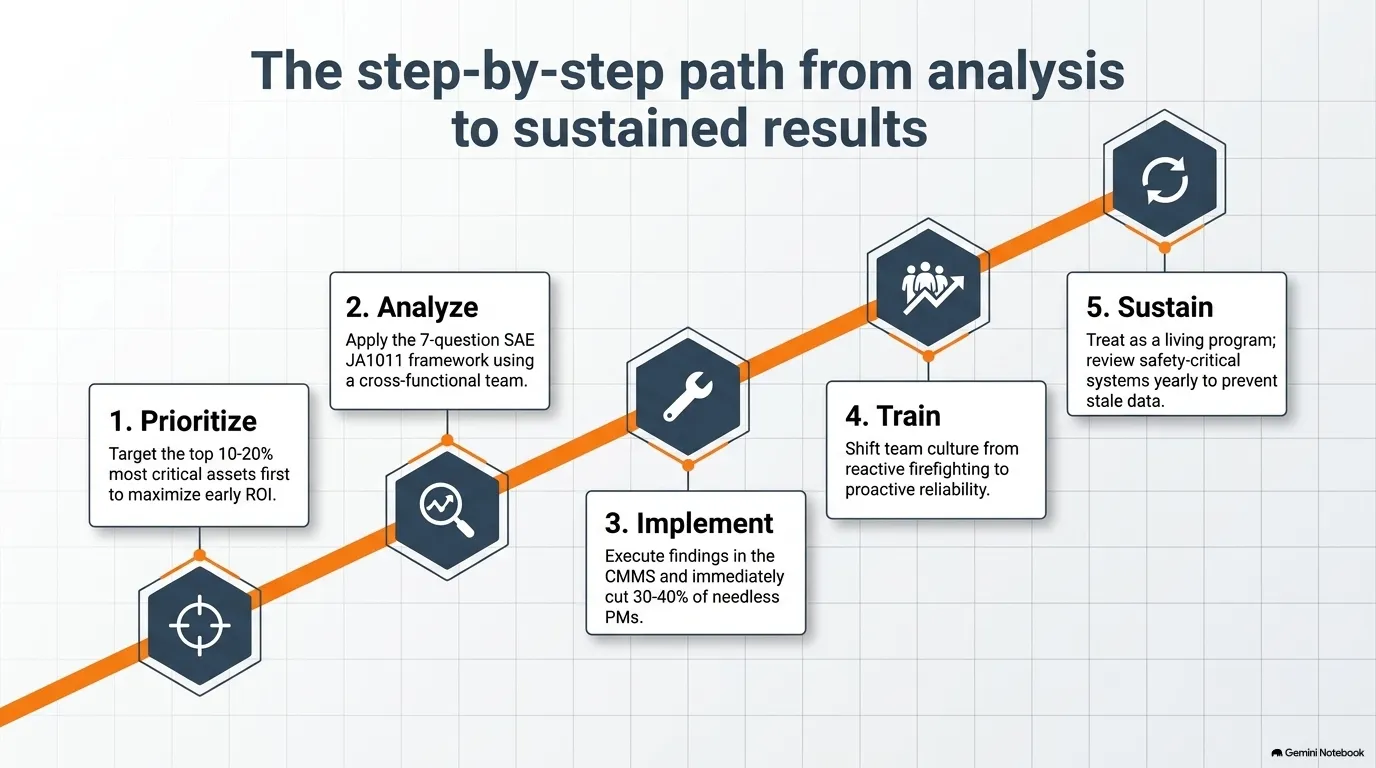
Getting RCM benefits takes more than doing the analysis. It needs a clear setup path. Furthermore, the 5-step process below turns the analysis into measured results.
Step 1: Prioritize Assets
Start with your most critical assets. These are the ones whose failure has safety, environmental, or big production impact. Specifically, rank gear by criticality, then run RCM on the top 10-20% first. Therefore, you grab the highest-value benefits before you scale to less critical assets.
Step 2: Perform the RCM Analysis
Run the 7-question RCM analysis per SAE JA1011 on each top asset. Furthermore, use a cross-functional team (ops, maintenance, engineering) led by a trained RCM facilitator. Log functions, failure modes, consequences, and tasks in a worksheet. For the full method, see our RCM analysis guide.
Step 3: Implement Selected Tasks
Move RCM-selected tasks into your CMMS as work orders. Furthermore, drop the needless PMs the analysis flags. This is where the 30-40% PM cut shows up. Moreover, link condition-based tasks (vibration, oil analysis, thermography) to your condition monitoring program.
Step 4: Train & Communicate
Train techs on the new task list. Explain why each task exists. Furthermore, share the RCM analysis with ops so they grasp the strategy and its basis. Consequently, the culture shifts from reactive firefighting to proactive reliability here. For foundational training, see our RCM training and RCM course resources.
Step 5: Review & Sustain
RCM is a living program, not a one-time task. Furthermore, review analyses yearly for safety-critical systems and every two years for non-critical assets. Update analyses when conditions change, new failure data shows up, or gear gets modified. Therefore, the benefits grow over time as the program matures. For firms pursuing ISO 55000, RCM gives the analytical base. For a general overview, see RCM on Wikipedia.

Disadvantages & Limitations of RCM
.”
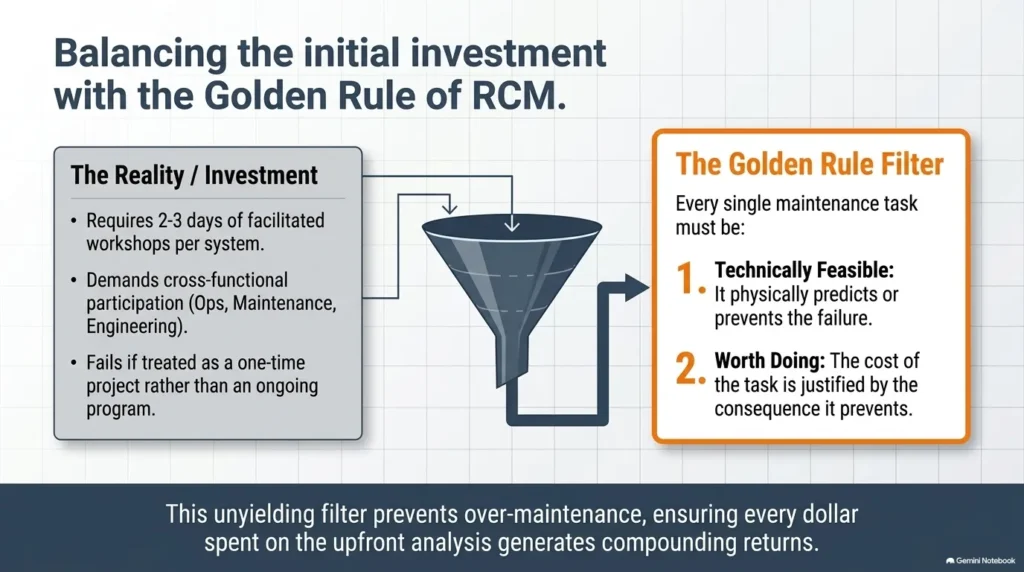
For a balanced view, RCM has drawbacks and limits. Firms should grasp these before they invest. Furthermore, knowing these challenges helps set realistic goals and plan ahead.
| Disadvantage | Detail | Mitigation |
|---|---|---|
| High upfront investment | 2-3 days of facilitated workshops per system + facilitator cost | Start with highest-criticality assets to maximize ROI |
| Requires trained facilitators | RCM methodology must be applied correctly or results are invalid | Train internal facilitators or hire consultants initially |
| Cross-functional team required | Operations, maintenance, and engineering must participate | Schedule workshops in advance; secure executive sponsorship |
| Can be misapplied as one-time exercise | Without ongoing review, analysis becomes stale | Treat RCM as a living program with scheduled reviews |
| Analysis can be time-consuming | Detailed analysis of complex systems takes weeks | Use software tools to accelerate; prioritize by criticality |
| Over-analysis risk | Applying RCM to non-critical assets wastes effort | Apply RCM only to assets where failure has consequences |
| Requires data quality | Analyses based on poor failure history produce poor results | Improve CMMS data quality before starting RCM |
Consequently, the most common failure mode of RCM is not the methodology — it is treating RCM as a one-time project rather than a living program. Specifically, organizations that perform RCM once and never review the analyses lose the benefits as operating conditions change. Therefore, plan for ongoing review from the start. Moreover, the over-analysis risk is real: applying RCM to every asset, including non-critical ones, wastes effort that should be focused on assets where failure matters. For more on applying RCM selectively, see our RCM example guide.
Frequently Asked Questions
These questions address the most common searches around reliability centered maintenance benefits, including all PAA questions. For the full set of reliability questions, see our FAQs hub.
What are the benefits of reliability centered maintenance?
Reliability centered maintenance benefits include 20-50% reduced unplanned downtime, 15-25% maintenance cost reduction, 30-40% elimination of unnecessary preventive maintenance tasks, 5-15% improved asset availability, and 10-30% fewer safety incidents. Furthermore, RCM provides defensible, consequence-driven maintenance decisions that satisfy regulators and auditors in safety-critical industries. Therefore, RCM delivers both operational and compliance benefits.
What are the disadvantages of reliability-centered maintenance?
The main disadvantages of reliability centered maintenance are the high upfront investment in analysis time (typically 2-3 days per system of facilitated workshops), the need for trained facilitators, and the requirement for cross-functional team participation. Furthermore, RCM can be misapplied as a one-time exercise rather than a living program, which limits its benefits. Consequently, without ongoing review, the analysis becomes stale as operating conditions change. Therefore, plan for ongoing review from the start to avoid this pitfall.
What does reliability-centered maintenance mean?
Reliability-centered maintenance (RCM) is a structured methodology defined in SAE JA1011 that determines optimal maintenance strategies by answering 7 fundamental questions about each asset’s functions, failure modes, and consequences. Specifically, RCM is consequence-driven rather than asset-driven, meaning identical equipment can receive different maintenance strategies based on the consequences of their failure in context. For the full definition, see our reliability centered maintenance guide.
What is the reliability-centered maintenance golden rule?
The reliability-centered maintenance golden rule is that every selected maintenance task must be both technically feasible and worth doing. Specifically, technically feasible means the task can predict or prevent the failure; worth doing means the task cost is justified by the failure consequence it addresses. Therefore, a task that fails either criterion should not be performed — this rule prevents both over-maintenance (performing unnecessary tasks) and under-maintenance (skipping necessary tasks).
How long does it take to realize RCM benefits?
RCM benefits realize at different timelines: eliminating unnecessary PMs (3-6 months), reducing downtime (6-12 months), lowering maintenance cost (12-18 months), and reducing safety incidents (12-24 months). Furthermore, the audit-trail and defensible-decision benefits are immediate once the analysis is documented. Therefore, some benefits appear quickly while others compound over 1-2 years as the living program matures.
Is RCM worth the investment?
Yes, RCM is worth the investment for organizations with safety-critical or high-value assets. Specifically, a typical plant investing $50,000-$150,000 in RCM can expect $200,000-$1,000,000+ in annual benefits — a payback period of 3-12 months. Moreover, the benefits compound over time as the program matures. However, for organizations with only non-critical assets or no meaningful failure consequences, the ROI may be lower. Therefore, prioritize RCM for assets where failure has safety, environmental, or significant economic consequences.
Ready to Realize RCM Benefits?
Reliability centered maintenance delivers measurable benefits — reduced downtime, lower costs, fewer safety incidents, and defensible maintenance decisions. Furthermore, the ROI is compelling for any organization with critical assets. To build the skills needed to lead RCM and realize these benefits, start with a free RCM practice test to assess your baseline. Then explore our RCM training and RCM course guides. For the complete methodology, read our reliability centered maintenance guide and the RCM analysis resource. When you are ready, view all exam simulators and take the next step toward your reliability career.
ReliabilityPath builds exam simulators for CMRP, CAMA, and RCM certifications, grounded in the SAE JA1011/JA1012 standards and the SMRP Body of Knowledge.