



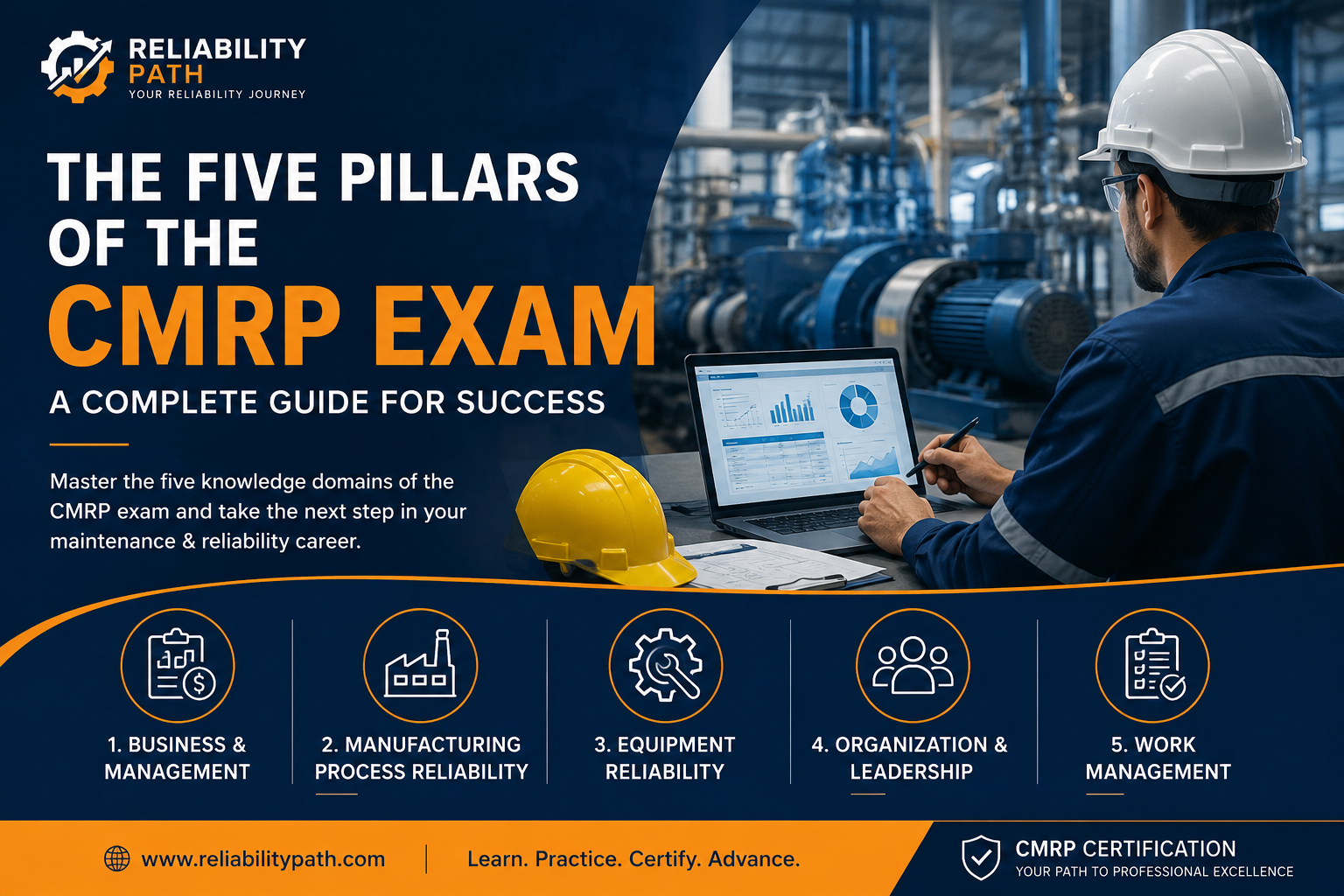
Everything you need to know about the five domains of the Certified Maintenance & Reliability Professional (CMRP) exam.
Introduction
The Certified Maintenance & Reliability Professional (CMRP) certification is recognized worldwide as one of the most respected credentials for maintenance and reliability professionals. Offered by the Society for Maintenance & Reliability Professionals (SMRP), the certification validates that an individual possesses the knowledge and skills required to improve equipment reliability, optimize maintenance processes, and contribute to business success.
Unlike many technical certifications, the CMRP exam is not solely about maintenance techniques. It evaluates your ability to think strategically, make data-driven decisions, and align maintenance activities with organizational goals.
The exam is structured around five knowledge domains—commonly known as the Five Pillars. Understanding these pillars is essential for passing the exam and becoming a more effective reliability professional.
Pillar 1: Business & Management (Approximately 20%)
What is it?
Business & Management focuses on aligning maintenance and reliability activities with the organization’s strategic objectives. The CMRP expects maintenance professionals to understand how their decisions affect production, profitability, safety, and long-term business performance.
Maintenance is no longer viewed as a cost center. Modern organizations expect maintenance teams to create value by reducing risk, improving asset performance, and supporting operational excellence.
Topics Covered
- Strategic planning
- Budgeting and cost control
- Financial analysis
- Asset management principles
- Risk management
- Regulatory compliance
- Key Performance Indicators (KPIs)
- Continuous improvement
- Leadership fundamentals
Example Scenario
A maintenance manager must choose between replacing an aging pump or continuing to repair it.
The correct decision should consider:
- Total lifecycle cost
- Equipment criticality
- Risk of failure
- Production impact
- Return on investment
The cheapest option is not always the best business decision.
Common Exam Mistake
Many candidates answer from a technician’s perspective rather than a business perspective.
Always ask yourself:
“Which decision creates the greatest long-term value for the organization?”
Pillar 2: Manufacturing Process Reliability (Approximately 17%)
What is it?
This pillar evaluates how maintenance supports production performance.
Reliable equipment alone does not guarantee reliable production. Maintenance professionals must understand how equipment failures affect manufacturing processes, product quality, customer satisfaction, and business performance.
Topics Covered
- Process flow
- Bottleneck analysis
- Production constraints
- Quality improvement
- Capacity utilization
- Process optimization
- Waste reduction
- Lean manufacturing concepts
Example Scenario
A machine experiences only one failure every six months.
Although the failure frequency is low, every failure shuts down the entire production line for eight hours.
The machine should still be considered highly critical because of its impact on production.
Key Concept
Always evaluate equipment failures based on:
- Production loss
- Customer impact
- Safety consequences
- Financial risk
Pillar 3: Equipment Reliability (Approximately 23%)
What is it?
This is often considered the heart of the CMRP exam.
Equipment Reliability focuses on maximizing asset performance throughout its lifecycle while minimizing failures and maintenance costs.
This pillar requires strong technical knowledge combined with analytical thinking.
Topics Covered
- Reliability engineering
- Failure modes
- Root Cause Analysis (RCA)
- Reliability Centered Maintenance (RCM)
- Failure Modes and Effects Analysis (FMEA)
- Criticality analysis
- Preventive Maintenance (PM)
- Predictive Maintenance (PdM)
- Condition Monitoring
- Precision Maintenance
- Lubrication
- Asset lifecycle management
Important Reliability Tools
Candidates should understand:
- FMEA
- RCA
- RCM
- Weibull Analysis
- P-F Curve
- Failure Patterns
- Condition Monitoring Technologies
Example Scenario
A bearing fails every four months despite regular replacement.
The correct approach is not to increase replacement frequency.
Instead, investigate the underlying cause using Root Cause Analysis.
Possible causes include:
- Misalignment
- Poor lubrication
- Contamination
- Improper installation
- Shaft imbalance
The CMRP emphasizes eliminating failure causes rather than repeatedly replacing components.
Pillar 4: Organization & Leadership (Approximately 20%)
What is it?
Even the best maintenance strategy will fail without effective leadership.
This pillar focuses on developing people, improving teamwork, and creating a culture of reliability.
Topics Covered
- Organizational design
- Leadership styles
- Coaching
- Employee development
- Competency management
- Communication
- Change management
- Team performance
- Contractor management
- Reliability culture
Example Scenario
A company invests in predictive maintenance technology.
However, technicians receive no training.
The project fails.
The problem is not technology.
The problem is leadership.
Successful reliability programs depend on people just as much as equipment.
Pillar 5: Work Management (Approximately 20%)
What is it?
Work Management ensures maintenance activities are planned, scheduled, executed, and documented efficiently.
Excellent planning dramatically reduces maintenance costs while improving equipment availability.
Topics Covered
- Work identification
- Work requests
- Work orders
- Job planning
- Scheduling
- Shutdown management
- Resource allocation
- Spare parts management
- CMMS
- Maintenance backlog
- Planning vs scheduling
- Performance measurement
Example Scenario
Two identical maintenance jobs are performed.
Team A spends:
- 3 hours repairing
- 5 hours searching for tools and parts
Team B spends:
- 3 hours repairing
- 30 minutes preparing
Both teams have equal technical ability.
The difference is planning.
Proper planning significantly improves maintenance efficiency.
How the Five Pillars Work Together
Many candidates study each pillar independently.
In reality, they are interconnected.
Consider a critical compressor failure:
- Business & Management: Evaluate financial impact and business risk.
- Manufacturing Process Reliability: Assess production downtime.
- Equipment Reliability: Identify the failure mechanism.
- Organization & Leadership: Coordinate communication and decision-making.
- Work Management: Plan and execute the repair efficiently.
The CMRP exam frequently presents scenarios that require knowledge from multiple pillars.
Study Tips for Each Pillar
Business & Management
- Learn maintenance KPIs.
- Understand budgeting and lifecycle cost concepts.
- Think like a business leader.
Manufacturing Process Reliability
- Understand production systems.
- Learn bottleneck analysis.
- Focus on value creation.
Equipment Reliability
- Master reliability engineering fundamentals.
- Practice failure analysis.
- Study condition monitoring techniques.
Organization & Leadership
- Learn communication and change management principles.
- Understand team development and reliability culture.
Work Management
- Understand the complete work order process.
- Learn planning versus scheduling.
- Practice CMMS-related concepts.
Common Mistakes Candidates Make
- Memorizing definitions instead of understanding concepts.
- Ignoring the business perspective.
- Focusing only on technical questions.
- Confusing planning with scheduling.
- Choosing reactive solutions instead of proactive strategies.
- Not practicing scenario-based questions.
Remember, the CMRP exam tests judgment—not memorization.
Final Thoughts
Passing the CMRP exam is about more than earning a certification. It represents a shift in mindset—from fixing equipment after failures occur to managing assets strategically and improving organizational performance.
Each of the Five Pillars contributes to that goal. Whether you’re developing maintenance strategies, analyzing failures, leading teams, or optimizing work processes, success comes from understanding how these domains work together to create reliable, efficient, and profitable operations.
Master the Five Pillars, and you’ll be well on your way to becoming not only a Certified Maintenance & Reliability Professional but also a stronger leader in the field of maintenance and asset management.
Ready to Test Your Knowledge?
Understanding the Five Pillars is only the first step. The best way to prepare for the CMRP exam is through realistic, scenario-based practice questions that reflect the style and complexity of the actual exam.
At Reliability Path, our CMRP Simulation Exams are designed to help you identify knowledge gaps, strengthen your decision-making skills, and build the confidence needed to pass the exam on your first attempt.
Start practicing today and take the next step toward becoming a Certified Maintenance & Reliability Professional.